Introduction
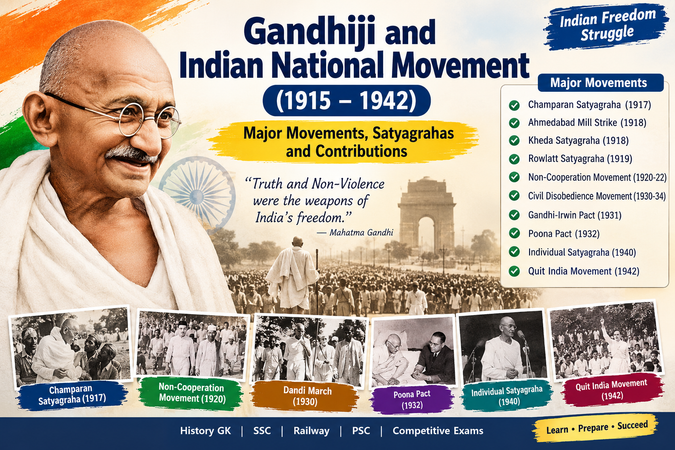
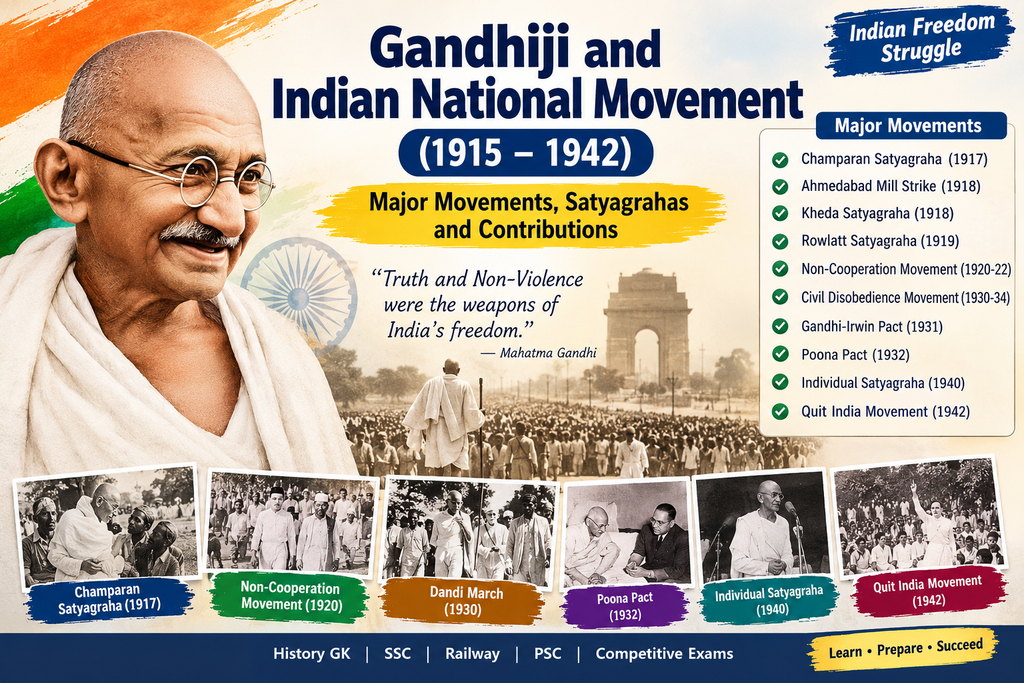
Gandhiji and Indian National Movement is one of the most important topics in Modern Indian History. Mahatma Gandhi transformed India’s freedom struggle into a mass movement based on the principles of Truth (Satya) and Non-Violence (Ahimsa). After returning from South Africa in 1915, Gandhi led several movements against British rule and inspired millions of Indians to participate in the struggle for independence.
From the Champaran Satyagraha of 1917 to the Quit India Movement of 1942, Gandhi played a central role in shaping India’s national movement. This article discusses the major events, movements and contributions of Mahatma Gandhi in chronological order.
https://culture.gov.in/mahatma-gandhi
Gandhiji’s Emergence
- Mahatma Gandhi was born on 2 October 1869 at Porbandar, Gujarat.
- His father was Karamchand Uttamchand Gandhi, and his mother was Putlibai.
- Gandhiji was a vegetarian and belonged to a Jain-influenced merchant community.
- He qualified as a Barrister in England and returned to India in 1891. In 1892, he went to South Africa.
- On 9 January 1915, he returned to India. Pravasi Bharatiya Divas is celebrated every year on this day.
- Natal, South Africa, was the main centre of Gandhiji’s activities during his early years there.
- Gandhiji’s autobiography is “My Experiments with Truth”, originally written in Gujarati. It was translated into English by Mahadev Desai.
- In 1909, Gandhiji wrote “Hind Swaraj” (Indian Home Rule) while travelling from England to South Africa. In Hind Swaraj, Gandhi stated that the real enemy was not British political domination alone, but modern industrial civilization as a whole.
- Gandhiji wrote for the “Indian Opinion” from 1903 to 1915 while he was in South Africa.
- In Indulal Yajnik’s “Young India”, Gandhiji wrote from 1919 to 1931, during the Khilafat and Non-Cooperation movements.
- Gandhiji’s favourite devotional song was “Vaishnava Jana To”, written by Narsinh Mehta.
- From 1933, Gandhiji wrote in the journal “Harijan” during the Civil Disobedience Movement. The publication of “Navajivan” began again on 1 November 1947 with Gandhiji’s blessings.
- In 1894, Gandhiji founded the Natal Indian National Congress (NINC) in South Africa.
- Gandhiji’s two important principles were “Satyagraha” and “Ahimsa.” Satyagraha means a firm commitment to truth.
- Gandhiji developed the concept of Satyagraha from John Ruskin’s book “Unto This Last.”
- He adopted the principle of Ahimsa (non-violence) from Leo Tolstoy’s book “The Kingdom of God is Within You.”
- The Indian Relief Act (1914) was the result of discussions between Gandhiji and General Jan Christiaan Smuts, a leading figure in the South African government.
- Rabindranath Tagore addressed Gandhiji as “Mahatma.” Netaji Subhas Chandra Bose referred to him as the “Father of the Nation.”
- Gandhiji’s political guru was Gopal Krishna Gokhale.
- Gandhiji’s first major public appearance in India was at the opening ceremony of Banaras Hindu University (BHU) in February 1916.
Major Movements Lead by Gandhi
1. Champaran Satyagraha (1917)
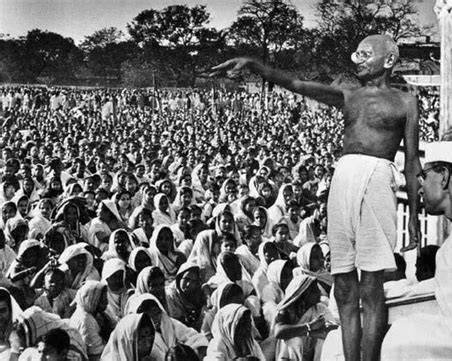
The first successful Satyagraha in India was launched in Champaran, Bihar.
Causes
- Peasants were forced to cultivate indigo under the oppressive Tinkathia system.
- Local leader Raj Kumar Shukla requested Gandhi to visit Champaran.
Result
- Gandhi investigated the grievances of peasants.
- The British government accepted several demands.
- It became Gandhi’s first major victory in India.
Important Leaders
- Raj Kumar Shukla
- Rajendra Prasad
- J. B. Kripalani
- Mahadev Desai
2. Ahmedabad Mill Strike (1918)
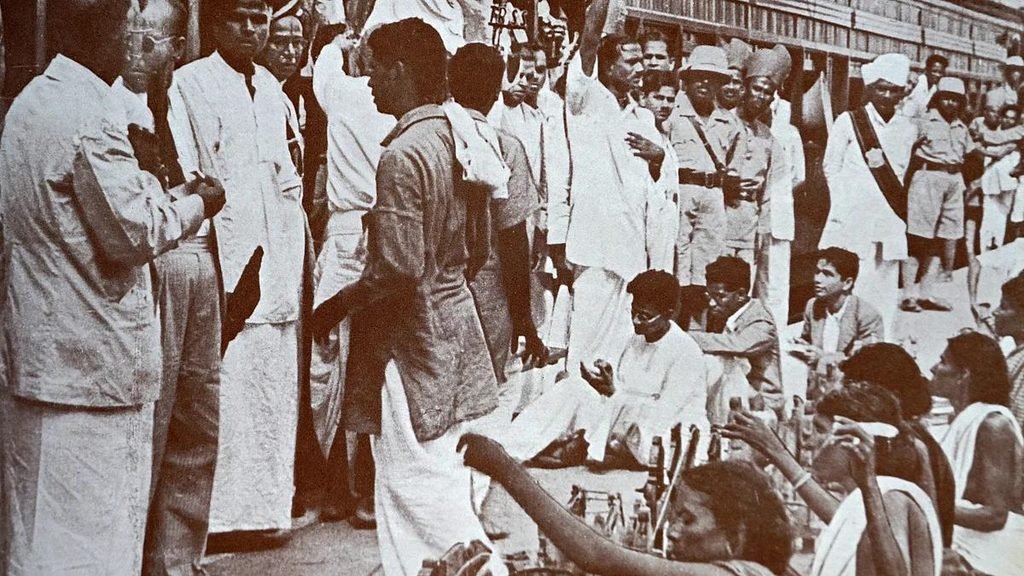
This movement was related to the rights of textile mill workers.
Causes
- Workers demanded higher wages.
Gandhi’s Role
- Gandhi supported the workers.
- He went on a fast to press their demands.
Result
- Workers received increased allowances and wages.
3. Kheda Satyagraha (1918)
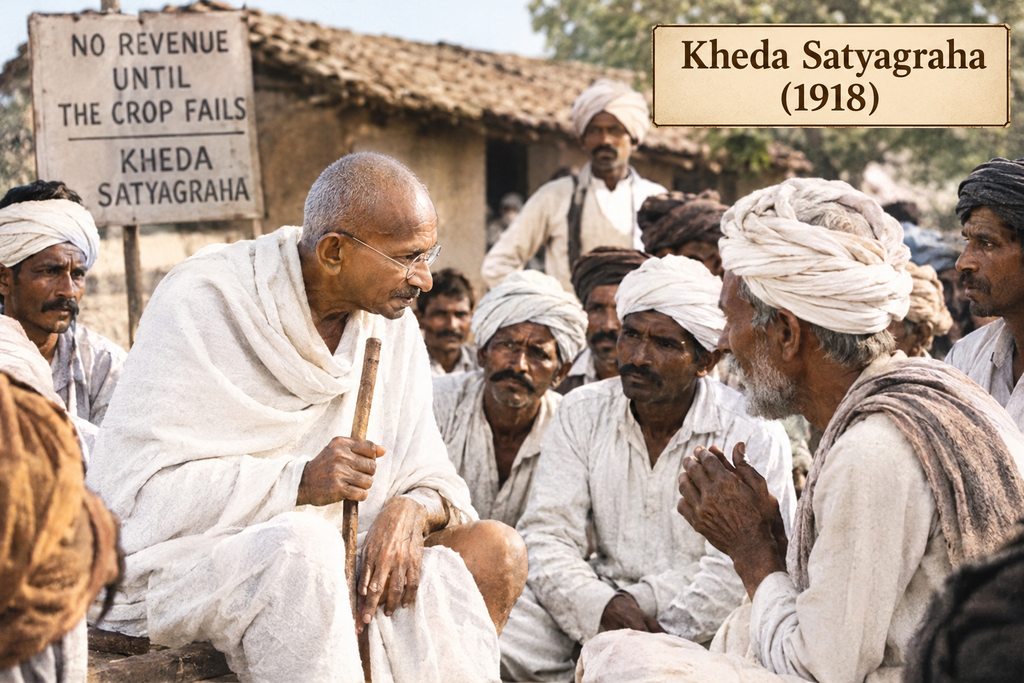
This movement was launched in Gujarat.
Causes
- Crop failure caused severe hardship for farmers.
- Farmers demanded suspension of land revenue collection.
Leaders
- Sardar Vallabhbhai Patel
- Indulal Yagnik
Result
- Revenue collection was suspended for affected peasants.
4. Rowlatt Satyagraha (1919)
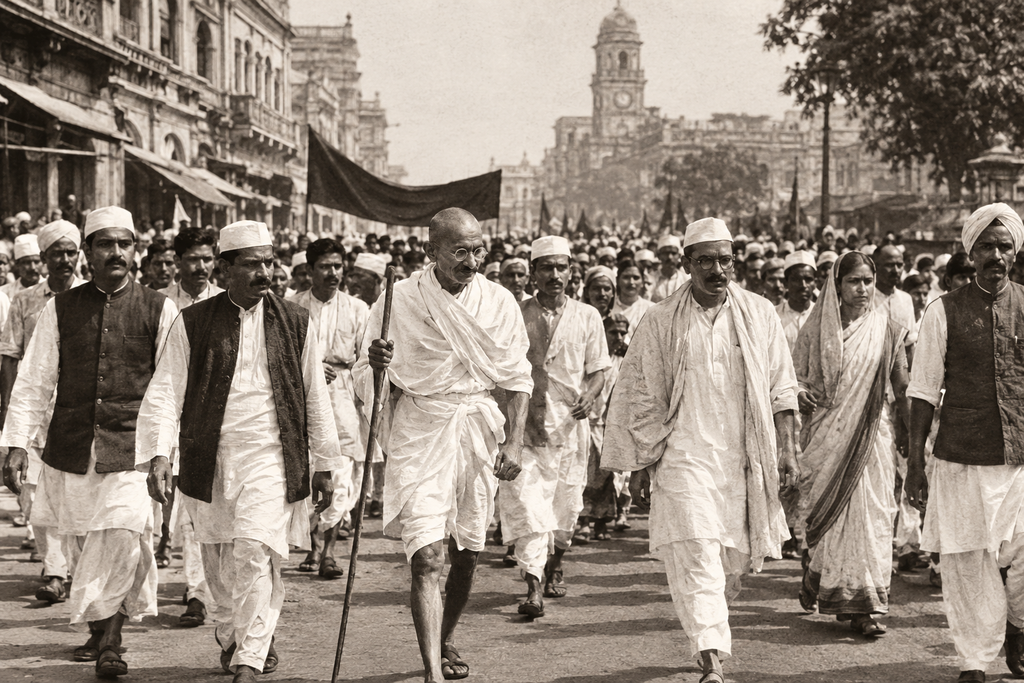
The British government passed the Rowlatt Act, allowing detention without trial.
Gandhi’s Response
- Gandhi called for a nationwide protest.
- A countrywide strike was observed on 6 April 1919.
Jallianwala Bagh Tragedy
On 13 April 1919, British troops opened fire on a peaceful gathering at Jallianwala Bagh, Amritsar.
Result
- Gandhi withdrew the movement.
- He later called it a “Himalayan Blunder.”
5. Non-Cooperation Movement (1920-1922)
The Non-Cooperation Movement was launched on 1 August 1920.
Objectives
- Boycott British institutions.
- Boycott foreign goods.
- Promote Swadeshi.
Impact
Millions of Indians participated in the movement.
Withdrawal
After the Chauri Chaura incident, Gandhi withdrew the movement in 1922.
He was arrested on 10 March 1922 and sentenced to six years’ imprisonment.
6. Civil Disobedience Movement (1930-1934)
The Civil Disobedience Movement marked a new phase in the freedom struggle.
Salt Satyagraha (Dandi March)
On 6 April 1930, Gandhi broke the Salt Law at Dandi.
This event became a symbol of resistance against British rule.
First Round Table Conference
The Indian National Congress boycotted the First Round Table Conference.
Gandhi-Irwin Pact (1931)
On 5 March 1931, Gandhi and Lord Irwin signed the Gandhi-Irwin Pact.
Main Outcome
- Gandhi agreed to suspend the Civil Disobedience Movement.
- Congress agreed to participate in the Second Round Table Conference.
Second Round Table Conference (1931)
Gandhi attended the conference as the representative of the Indian National Congress.
However, the conference failed to achieve a satisfactory political settlement.
Communal Award (1932)
In August 1932, British Prime Minister Ramsay MacDonald announced the Communal Award.
Features
- Separate representation for various communities.
- Led to political controversy across India.
Gandhi opposed certain provisions and began a fast in Yerwada Jail.
Poona Pact (1932)
The Poona Pact was signed between:
- Mahatma Gandhi
- Dr. B. R. Ambedkar
Significance
- Resolved the dispute over separate electorates.
- Increased reserved seats for the Depressed Classes within a joint electorate system.
Second Phase of Civil Disobedience Movement (1932-1934)
After returning from the Second Round Table Conference, Gandhi resumed the movement.
Important Developments
- Movement restarted on 3 January 1932.
- Gandhi increasingly focused on the upliftment of Harijans (Dalits).
- The movement was finally withdrawn in 1934.
7. Individual Satyagraha (1940)
In 1940, Congress authorized Gandhi to launch a limited movement against British policies.
First Individual Satyagrahi
Vinoba Bhave became the first Individual Satyagrahi on 17 October 1940.
Second Individual Satyagrahi
Jawaharlal Nehru became the second Individual Satyagrahi on 31 October 1940.
8. Quit India Movement (1942)
The Quit India Movement was launched on 9 August 1942.
Background
- Failure of the Cripps Mission.
- Growing demand for complete independence.
Features
- Mass participation across India.
- Famous slogan: “Do or Die”
Significance
The movement demonstrated the determination of Indians to end British rule and paved the way for independence.
Conclusion
The story of Gandhiji and Indian National Movement is the story of India’s struggle for freedom through truth, non-violence and mass participation. From Champaran Satyagraha to the Quit India Movement, Gandhi transformed the national movement into a people’s movement. His leadership, moral courage and commitment to justice continue to inspire generations and remain an important part of India’s history.
People also read
Olympic Games History: Host Cities, India’s Medal Winners & Important Facts
Olympic Games History, Host Cities & India Medal Winners
Important Inventions, Discoveries and Inventors: Complete GK List for Competitive Exams
Important Inventions and Inventors: List, Year, Country & Discoveries
Current Afairs for Competitive Exams in Hindi : 2026 – 2027
Current Afairs for Competitive Exams in Hindi : 2026 – 2027
BRICS Summit 2026: A Comprehensive Guide to Its Global Impact, Agenda and What Comes Next
BRICS Summit 2026: India, New Delhi Declaration, Members and Key Highlights
जनगणना 2027: भारत की प्रथम डिजिटल जनगणना
जनगणना 2027: भारत की प्रथम डिजिटल जनगणना Explained
Public Examinations (Prevention of Unfair Means) Amendment Act 2026: क्या बदला, नई सजा, जुर्माना और प्रमुख प्रावधान
Public Examinations (Prevention of Unfair Means) Amendment Act 2026:
Commonwealth Games 2026: India Medal Winners, Medal Tally and Important Facts
Commonwealth Games 2026: India Medal Winners, Medal Tally