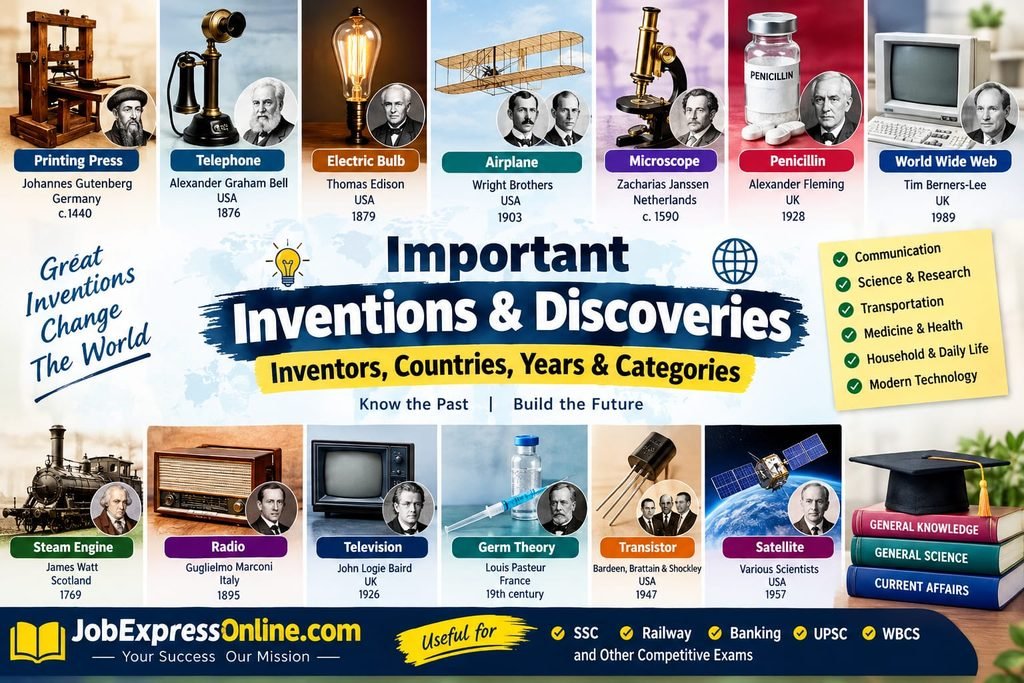
Human civilization has progressed through thousands of important inventions and scientific discoveries. From the printing press and telescope to the telephone, airplane, television, computer and internet, inventions have transformed communication, transportation, medicine, science and everyday life.
For competitive examinations such as SSC, Railway, Banking, UPSC, State PSC, WBCS and other government-job examinations, questions related to inventions and inventors are frequently included in General Knowledge and General Science sections.
This article provides a useful inventions and discoveries list with the inventor or key contributor, country, year and category. Where an invention developed through the work of several people, the table uses the person or people most commonly associated with the relevant milestone.
Important Inventions and Discoveries List :
1. Communication and Information Technology
| Invention / Discovery | Inventor / Key Contributor | Country | Year |
|---|---|---|---|
| Printing Press | Johannes Gutenberg | Germany | c. 1440 |
| Telegraph | Samuel Morse | USA | 1837 |
| Telephone | Alexander Graham Bell | USA | 1876 |
| Phonograph | Thomas Edison | USA | 1877 |
| Radio / Wireless Telegraphy | Guglielmo Marconi | Italy | 1895 |
| Television – Mechanical System | John Logie Baird | UK | 1926 |
| Television – Electronic System | Philo Farnsworth | USA | 1927 |
| Radar | Robert Watson-Watt and others | UK | 1930s |
| Transistor | Bardeen, Brattain and Shockley | USA | 1947 |
| Computer – Early Electronic Computer | Multiple contributors | USA/UK | 1940s |
| Microprocessor | Intel team | USA | 1971 |
| Ray Tomlinson | USA | 1971 | |
| Mobile Phone | Martin Cooper | USA | 1973 |
| World Wide Web | Tim Berners-Lee | UK | 1989 |
The Library of Congress records Bell’s successful telephone patent and 1876 demonstrations, while Library of Congress telecommunications history places Morse’s first public telegraph message in 1844 and Marconi’s wireless work in the late 19th century.
2. Science and Measurement
| Invention / Discovery | Inventor / Key Contributor | Country | Year |
|---|---|---|---|
| Microscope | Zacharias Janssen – commonly credited | Netherlands | c. 1590 |
| Telescope | Hans Lippershey – commonly credited | Netherlands | 1608 |
| Thermometer | Galileo Galilei – early thermoscope | Italy | c. 1593 |
| Barometer | Evangelista Torricelli | Italy | 1643 |
| Pendulum Clock | Christiaan Huygens | Netherlands | 1656 |
| Calculating Machine | Blaise Pascal | France | 1642 |
| Lightning Rod | Benjamin Franklin | USA | 1752 |
| Electromagnetic Induction | Michael Faraday | UK | 1831 |
| X-Ray | Wilhelm Conrad Röntgen | Germany | 1895 |
| Radioactivity | Henri Becquerel | France | 1896 |
| Radium | Marie Curie and Pierre Curie | France/Poland | 1898 |
| Electron – Discovery | J. J. Thomson | UK | 1897 |
| Atomic Theory | John Dalton | UK | 1803 |
| Quantum Theory | Max Planck | Germany | 1900 |
| Theory of Relativity | Albert Einstein | Germany/Switzerland | 1905 |
Exam note: The dates of some early instruments can vary because their development was gradual. For example, sources commonly list the telescope around 1608 and the microscope around 1590.
3. Transportation and Engineering
| Invention | Inventor / Key Contributor | Country | Year |
|---|---|---|---|
| Steam Engine | Thomas Newcomen; later improved by James Watt | England/Scotland | 1712/1769 |
| Steam Locomotive | Richard Trevithick | UK | 1804 |
| Railway Locomotive | George Stephenson | UK | 1814 |
| Bicycle | Kirkpatrick Macmillan – commonly credited | Scotland | 1839 |
| Automobile | Karl Benz | Germany | 1885–1886 |
| Motorcycle | Gottlieb Daimler and Wilhelm Maybach | Germany | 1885 |
| Diesel Engine | Rudolf Diesel | Germany | 1897 |
| Airplane | Wilbur and Orville Wright | USA | 1903 |
| Helicopter | Igor Sikorsky | USA | 1939 |
The Smithsonian records the Wright brothers’ 1903 Flyer as the first successful powered airplane with a pilot aboard, with its first flight on December 17, 1903, in the United States.
4. Medical Science and Medicine
| Invention / Discovery | Inventor / Scientist | Country | Year |
|---|---|---|---|
| Stethoscope | René Laennec | France | 1816 |
| Anesthesia – Ether Use in Surgery | William T. G. Morton and others | USA | 1846 |
| Germ Theory | Louis Pasteur and others | France | 19th century |
| Antiseptic Surgery | Joseph Lister | UK | 1860s |
| Blood Circulation | William Harvey | England | 1628 |
| Smallpox Vaccine | Edward Jenner | England | 1796 |
| Penicillin | Alexander Fleming | UK | 1928 |
| Insulin – Therapeutic Development | Banting, Best, Macleod and Collip | Canada | 1921–1922 |
| Streptomycin | Selman Waksman and Albert Schatz | USA | 1943 |
| Polio Vaccine – Oral | Albert Sabin | USA | 1961 |
| Open-heart Surgery – Major Development | Various surgeons | Multiple countries | 20th century |
Important distinction: discoveries such as blood circulation or radioactivity should technically be called discoveries, while devices such as the stethoscope are inventions. Keeping both under “Inventions and Discoveries” makes the article more accurate for GK purposes.
5. Household and Everyday Inventions
| Invention | Inventor / Key Contributor | Country | Year |
|---|---|---|---|
| Safety Pin | Walter Hunt | USA | 1849 |
| Sewing Machine | Barthélemy Thimonnier and others | France | 1830 |
| Refrigerator – Early Mechanical Design | Jacob Perkins | UK | 1834 |
| Electric Bulb – Practical Incandescent Lamp | Thomas Edison and others | USA | 1879 |
| Safety Razor | King C. Gillette | USA | 1901 |
| Washing Machine – Early Electric Models | Multiple inventors | USA/Europe | Early 20th century |
| Ballpoint Pen | László Bíró | Hungary | 1938 |
| Nylon | Wallace H. Carothers and DuPont team | USA | 1935 |
| Stainless Steel | Harry Brearley – commonly credited | UK | 1913 |
| Terylene / Polyester | J. R. Whinfield and J. T. Dickson | UK | 1941 |
| Electric Transformer | William Stanley | USA | 1885 |
6. Modern Technology
| Invention / Technology | Key Contributor | Country | Year |
|---|---|---|---|
| Optical Fibre Communication | Narinder Singh Kapany and others | India/UK | 1950s–1960s |
| Integrated Circuit | Jack Kilby and Robert Noyce | USA | 1958–1959 |
| Laser | Theodore Maiman and earlier contributors | USA | 1960 |
| Microprocessor | Intel team | USA | 1971 |
| Personal Computer | Multiple contributors | USA | 1970s |
| Mobile Phone | Martin Cooper | USA | 1973 |
| Internet – Development | Multiple researchers | USA/UK and others | 1960s–1980s |
| World Wide Web | Tim Berners-Lee | UK | 1989 |
| USB | Ajay Bhatt and Intel team | USA | 1990s |
7. Important Inventions for Competitive Exams – Quick Revision
These are some of the most useful inventor–invention pairs to remember:
| Invention | Inventor | Year |
|---|---|---|
| Printing Press | Johannes Gutenberg | c. 1440 |
| Telescope | Hans Lippershey | 1608 |
| Barometer | Evangelista Torricelli | 1643 |
| Steam Engine | Thomas Newcomen / James Watt | 1712 / 1769 |
| Smallpox Vaccine | Edward Jenner | 1796 |
| Battery | Alessandro Volta | 1800 |
| Electromagnetic Induction | Michael Faraday | 1831 |
| Telegraph | Samuel Morse | 1837 |
| Telephone | Alexander Graham Bell | 1876 |
| Phonograph | Thomas Edison | 1877 |
| Electric Bulb | Thomas Edison and others | 1879 |
| Automobile | Karl Benz | 1885–86 |
| Radio | Guglielmo Marconi | 1895 |
| X-Ray | Wilhelm Röntgen | 1895 |
| Diesel Engine | Rudolf Diesel | 1897 |
| Airplane | Wright Brothers | 1903 |
| Television | John Logie Baird | 1926 |
| Penicillin | Alexander Fleming | 1928 |
| Ballpoint Pen | László Bíró | 1938 |
| Transistor | Bardeen, Brattain & Shockley | 1947 |
| Laser | Theodore Maiman | 1960 |
| Mobile Phone | Martin Cooper | 1973 |
| World Wide Web | Tim Berners-Lee | 1989 |
Important Note About “Inventor” Questions
Many GK books present an invention as if it was created by one person on one exact date. In reality, several inventions developed gradually through the contributions of multiple scientists and engineers.
For example:
- Steam engine: Thomas Newcomen developed an early practical atmospheric steam engine; James Watt later made major improvements.
- Telephone: Bell is commonly credited because of his successful patented design and demonstrations, although other inventors also worked on voice communication.https://www.loc.gov/everyday-mysteries/categories/technology/item/who-is-credited-with-inventing-the-telephone/
- Radio: Marconi is commonly associated with wireless telegraphy, but radio technology developed through contributions from several scientists.
- Television: Baird is associated with early mechanical television, while electronic television involved other major contributors.
- Airplane: The Wright brothers’ 1903 flight is the milestone commonly used in GK questions for the first successful powered, controlled heavier-than-air flight.
Therefore, for competitive-exam preparation, students should remember the commonly accepted exam pair, while understanding that the complete historical story can be more complicated.
Conclusion
Inventions and scientific discoveries have played a major role in shaping modern civilization. Learning the names of important inventors, their inventions, countries and years is especially useful for General Knowledge and General Science preparation.
For competitive examinations, candidates should focus particularly on frequently asked pairs such as Gutenberg–Printing Press, Bell–Telephone, Edison–Electric Bulb, Marconi–Radio, Röntgen–X-Ray, Fleming–Penicillin, Wright Brothers–Airplane and Tim Berners-Lee–World Wide Web.
Regular revision through short tables and one-line questions can make this topic easier to remember for SSC, Railway, Banking, UPSC, WBCS and other competitive examinations.
People Also Read
Current Afairs for Competitive Exams in Hindi : 2026 – 2027
Current Afairs for Competitive Exams in Hindi : 2026 – 2027
BRICS Summit 2026: A Comprehensive Guide to Its Global Impact, Agenda and What Comes Next
BRICS Summit 2026: India, New Delhi Declaration, Members and Key Highlights
जनगणना 2027: भारत की प्रथम डिजिटल जनगणना
जनगणना 2027: भारत की प्रथम डिजिटल जनगणना Explained
Public Examinations (Prevention of Unfair Means) Amendment Act 2026: क्या बदला, नई सजा, जुर्माना और प्रमुख प्रावधान
Public Examinations (Prevention of Unfair Means) Amendment Act 2026:
Prevention of Insults to National Honour Amendment Bill 2026: Vande Mataram Legal Protection : वंदे मातरम् की कानूनी सुरक्षा का विस्तार
Prevention of Insults to National Honour Amendment Bill 2026: Vande Mataram Legal Protection
Commonwealth Games 2026: India Medal Winners, Medal Tally and Important Facts
Commonwealth Games 2026: India Medal Winners, Medal Tally
Commonwealth Games 2026: India Medal Winners, Medal Tally
How to Kickstart Government Job Prep in 2026
How to Kickstart Government Job Prep in 2026 – Job Express Online