Olympic Games History dates back to the ancient Olympic Games held in Olympia, Greece. The modern Olympic Games were revived in 1896 in Athens under the leadership of Pierre de Coubertin and have since become a major international sporting event.
In this article, we will explore the Olympic Games History, including the ancient and modern Olympics, important milestones, host countries, India’s medal winners and key facts useful for competitive exams and general knowledge.
Ancient vs. Modern Origins
Ancient Olympics: The ancient games trace back to 776 BC in Olympia, Greece, celebrated as a religious and athletic festival in honor of Zeus.
Modern Olympics: After centuries of dormancy, the first Modern Summer Olympic Games were inaugurated in 1896 in Athens, Greece.
The Father of the Modern Olympics
French educator and historian Baron Pierre de Coubertin is revered as the Father of the Modern Olympic Games. He established the International Olympic Committee (IOC) in 1894 to foster global peace through athletic competition.
The Olympic Symbol & Rings
The Olympic Flag made its debut at the 1920 Antwerp Games.
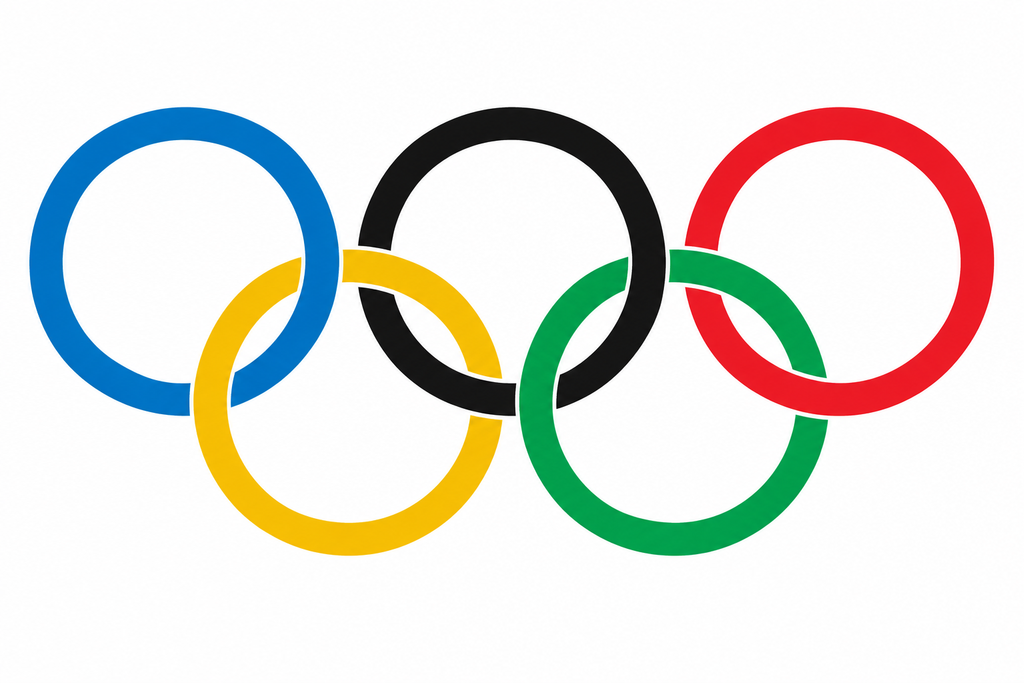
The five interlaced rings on a white backdrop represent the union of five inhabited continents and the meeting of athletes worldwide:
Blue: Europe
Yellow: Asia
Black: Africa
Green: Oceania / Australia
Red: Americas
Olympic Motto & Flame
Olympic Motto:Citius, Altius, Fortius (Latin for “Faster, Higher, Stronger”).
Olympic Flame (Sacred Fire): The modern tradition of the Olympic Flame was reintroduced during the 1928 Amsterdam Olympic Games, followed by the iconic Olympic Torch Relay starting from the 1936 Berlin Games.
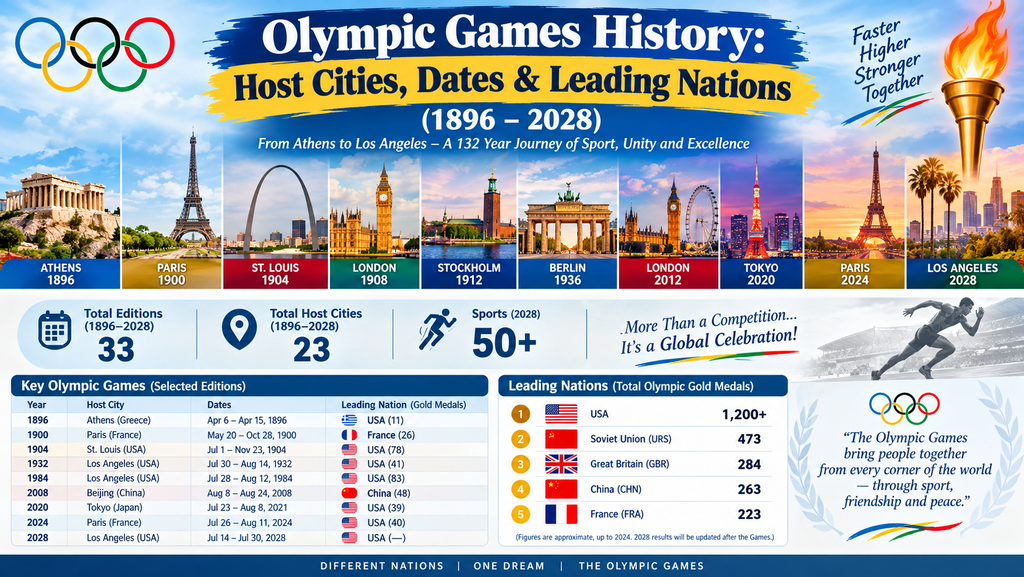
2. Olympic Games History: Host Cities, Dates & Leading Nations (1896–2028)
Below is the chronological journey of the Summer Olympic Games:
Year
Host City & Nation
Dates
Top-Ranked Nation
1896
Athens, Greece
6 April – 15 April
United States
1900
Paris, France
14 May – 28 October (Note: 11 Feb – 19 Feb)
United States
1904
St. Louis, USA
1 July – 23 November (Note: 4 Feb – 15 Feb)
United States
1908
London, Great Britain
27 April – 31 October
Great Britain
1912
Stockholm, Sweden
5 May – 22 July
Sweden
1916
Cancelled due to World War I
—
—
1920
Antwerp, Belgium
20 April – 12 September
United States
1924
Paris, France
4 May – 27 July
United States
1928
Amsterdam, Netherlands
17 May – 12 August
United States
1932
Los Angeles, USA
3 July – 14 August
United States
1936
Berlin, Germany
1 August – 16 August
Germany
1940–1944
Cancelled due to World War II
—
—
1948
London, Great Britain
9 July – 10 August
United States
1952
Helsinki, Finland
19 July – 3 August
Soviet Union (Russia)
1956
Melbourne, Australia
22 November – 8 December
Soviet Union (Russia)
1960
Rome, Italy
25 August – 11 September
Soviet Union (Russia)
1964
Tokyo, Japan
10 October – 24 October
United States
1968
Mexico City, Mexico
12 October – 27 October
United States
1972
Munich, West Germany
26 August – 10 September
Soviet Union (Russia)
1976
Montreal, Canada
17 July – 1 August
Soviet Union (Russia)
1980
Moscow, USSR
19 July – 3 August
Soviet Union (Russia)
1984
Los Angeles, USA
18 July – 12 August
United States
1988
Seoul, South Korea
17 September – 2 October
Soviet Union (Russia)
1992
Barcelona, Spain
25 July – 7 August
Unified Team / Russia
1996
Atlanta, USA
20 July – 4 August
United States
2000
Sydney, Australia
15 September – 1 October
United States
2004
Athens, Greece
13 August – 29 August
United States
2008
Beijing, China
8 August – 24 August
United States
2012
London, Great Britain
27 July – 12 August
United States
2016
Rio de Janeiro, Brazil
5 August – 21 August
United States
2020
Tokyo, Japan
23 July – 8 August, 2021
United States
2024
Paris, France
26 July – 11 August
United States
2028
Los Angeles, USA
14 July – 30 July
Upcoming
3. India’s Individual Olympic Medal Winners
India’s individual Olympic legacy features standout performances across multiple disciplines:
Year
Olympic Host
Athlete Name
Discipline & Event
Medal
1900
Paris
Norman Pritchard
Athletics (200m Sprint – 22.08s)
Silver
1900
Paris
Norman Pritchard
Athletics (200m Hurdles – 26.06s)
Silver
1952
Helsinki
Khashaba Dadasaheb Jadhav
Wrestling (Bantamweight)
Bronze
1996
Atlanta
Leander Paes
Tennis (Men’s Singles)
Bronze
2000
Sydney
Karnam Malleswari
Weightlifting (Women’s 69 kg)
Bronze
2004
Athens
Rajyavardhan Singh Rathore
Shooting (Men’s Double Trap)
Silver
2008
Beijing
Abhinav Bindra
Shooting (Men’s 10m Air Rifle)
Gold (First Individual Gold)
2008
Beijing
Vijender Singh
Boxing (Middleweight)
Bronze
2008
Beijing
Sushil Kumar
Wrestling (Men’s 66 kg)
Bronze
2012
London
Gagan Narang
Shooting (Men’s 10m Air Rifle)
Bronze
2012
London
Vijay Kumar
Shooting (Men’s 25m Rapid Fire Pistol)
Silver
2012
London
Saina Nehwal
Badminton (Women’s Singles)
Bronze
2012
London
Mary Kom
Boxing (Women’s Flyweight)
Bronze
2012
London
Yogeshwar Dutt
Wrestling (Men’s 60 kg)
Bronze
2012
London
Sushil Kumar
Wrestling (Men’s 66 kg)
Silver
2016
Rio
P. V. Sindhu
Badminton (Women’s Singles)
Silver
2016
Rio
Sakshi Malik
Wrestling (Women’s 58 kg)
Bronze
2020
Tokyo
Neeraj Chopra
Athletics (Men’s Javelin Throw)
Gold
2020
Tokyo
Ravi Kumar Dahiya
Wrestling (Men’s 57 kg)
Silver
2020
Tokyo
Mirabai Chanu
Weightlifting (Women’s 49 kg)
Silver
2020
Tokyo
P. V. Sindhu
Badminton (Women’s Singles)
Bronze
2020
Tokyo
Lovlina Borgohain
Boxing (Women’s Welterweight)
Bronze
2020
Tokyo
Bajrang Punia
Wrestling (Men’s 65 kg)
Bronze
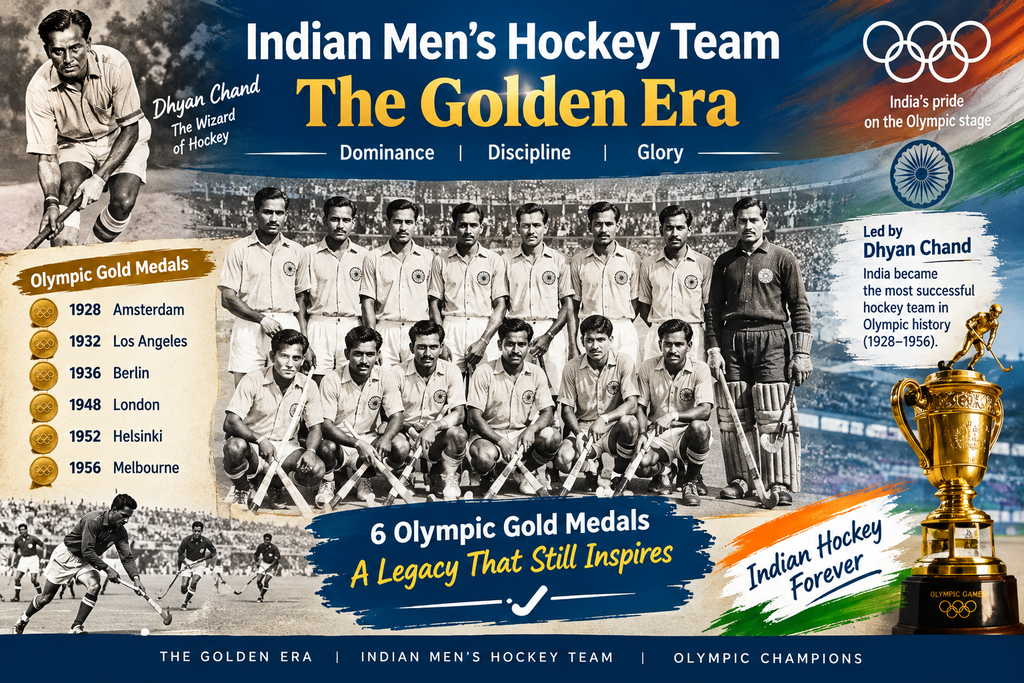
4. Indian Men’s Hockey Team: The Golden Era
Field hockey remains the crown jewel of Indian Olympic history, delivering a record 8 Gold medals:
Year
Olympic Host
Event
Medal
1928
Amsterdam
Men’s Field Hockey
Gold
1932
Los Angeles
Men’s Field Hockey
Gold
1936
Berlin
Men’s Field Hockey
Gold
1948
London
Men’s Field Hockey
Gold
1952
Helsinki
Men’s Field Hockey
Gold
1956
Melbourne
Men’s Field Hockey
Gold
1960
Rome
Men’s Field Hockey
Silver
1964
Tokyo
Men’s Field Hockey
Gold
1968
Mexico City
Men’s Field Hockey
Bronze
1972
Munich
Men’s Field Hockey
Bronze
1980
Moscow
Men’s Field Hockey
Gold
2020
Tokyo
Men’s Field Hockey
Bronze
Historic Father-Son Olympic Duos
Major Dhyan Chand & Ashok Kumar: Major Dhyan Chand secured Gold in 1936 (Berlin Hockey), while his son Ashok Kumar earned Bronze in 1972 (Munich Hockey).
Ahmed Sher Khan & Aslam Sher Khan: Ahmed Sher Khan was part of the 1936 Berlin Gold squad, and his son Aslam Sher Khan won Bronze in 1972 (Munich Hockey).
Dr. Vece Paes & Leander Paes: Dr. Vece Paes earned Bronze in 1972 (Munich Hockey), and his son Leander Paes secured Bronze in 1996 (Atlanta Men’s Singles Tennis).
5. Looking Forward: Los Angeles 2028 (LA28)
Event: Games of the XXXIV Olympiad (Summer Olympics 2028)
Host City: Los Angeles, California, USA
Scheduled Dates: 14 July – 30 July 2028
Major Highlight: LA28 marks the historic Olympic return of Twenty20 (T20) Cricket after 128 years, alongside newly added disciplines such as baseball/softball, flag football, lacrosse, and squash.
People also read
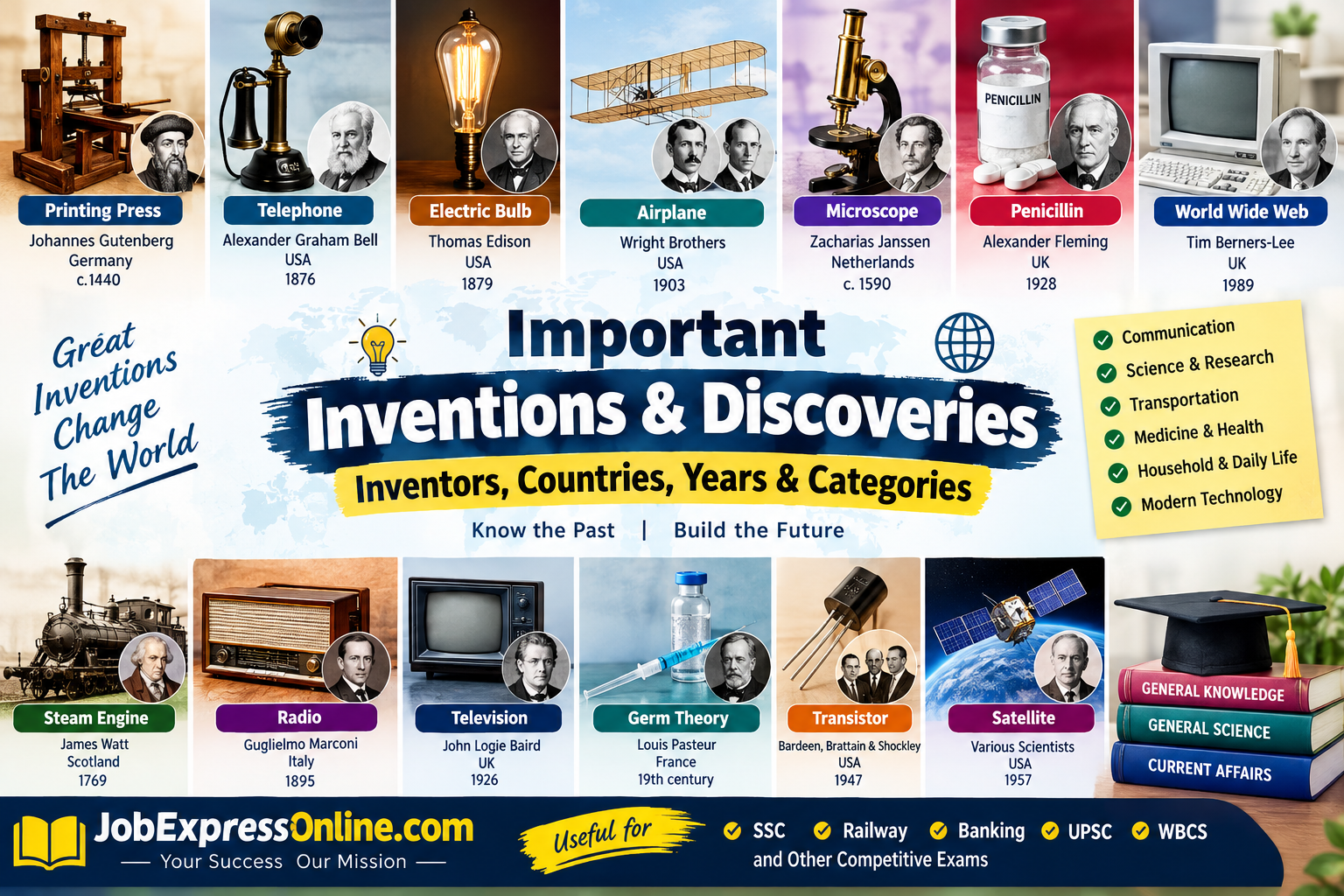
Important Inventions, Discoveries and Inventors: Complete GK List for Competitive Exams
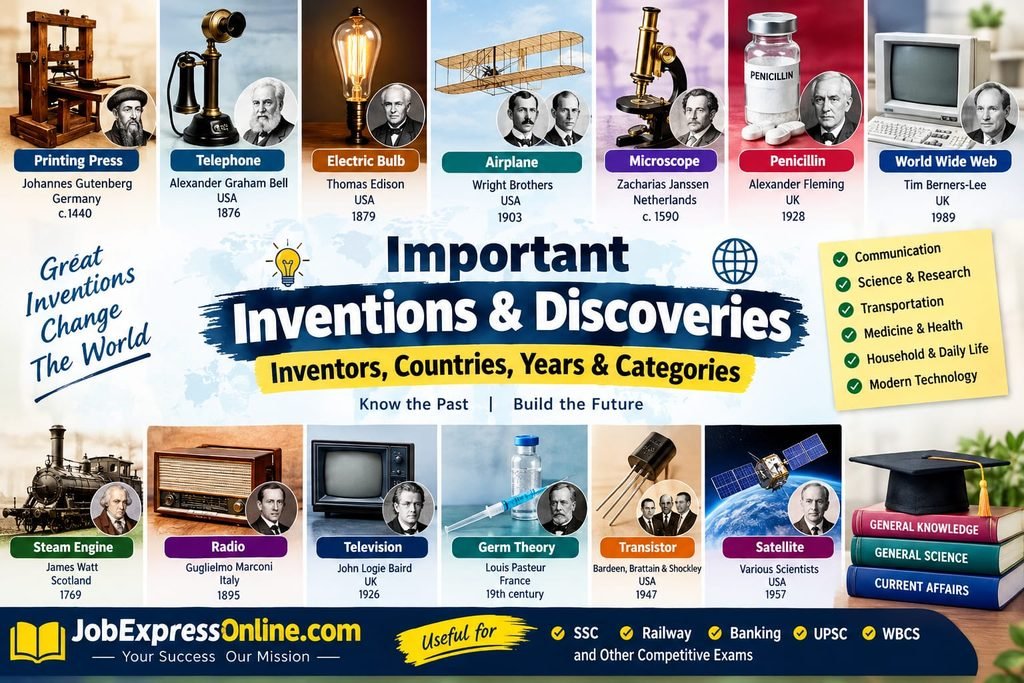
Human civilization has progressed through thousands of important inventions and scientific discoveries. From the printing press and telescope to the telephone, airplane, television, computer and internet, inventions have transformed communication, transportation, medicine, science and everyday life.
For competitive examinations such as SSC, Railway, Banking, UPSC, State PSC, WBCS and other government-job examinations, questions related to inventions and inventors are frequently included in General Knowledge and General Science sections.
This article provides a useful inventions and discoveries list with the inventor or key contributor, country, year and category. Where an invention developed through the work of several people, the table uses the person or people most commonly associated with the relevant milestone.
Important Inventions and Discoveries List :
1. Communication and Information Technology
Invention / Discovery
Inventor / Key Contributor
Country
Year
Printing Press
Johannes Gutenberg
Germany
c. 1440
Telegraph
Samuel Morse
USA
1837
Telephone
Alexander Graham Bell
USA
1876
Phonograph
Thomas Edison
USA
1877
Radio / Wireless Telegraphy
Guglielmo Marconi
Italy
1895
Television – Mechanical System
John Logie Baird
UK
1926
Television – Electronic System
Philo Farnsworth
USA
1927
Radar
Robert Watson-Watt and others
UK
1930s
Transistor
Bardeen, Brattain and Shockley
USA
1947
Computer – Early Electronic Computer
Multiple contributors
USA/UK
1940s
Microprocessor
Intel team
USA
1971
Email
Ray Tomlinson
USA
1971
Mobile Phone
Martin Cooper
USA
1973
World Wide Web
Tim Berners-Lee
UK
1989
The Library of Congress records Bell’s successful telephone patent and 1876 demonstrations, while Library of Congress telecommunications history places Morse’s first public telegraph message in 1844 and Marconi’s wireless work in the late 19th century.
2. Science and Measurement
Invention / Discovery
Inventor / Key Contributor
Country
Year
Microscope
Zacharias Janssen – commonly credited
Netherlands
c. 1590
Telescope
Hans Lippershey – commonly credited
Netherlands
1608
Thermometer
Galileo Galilei – early thermoscope
Italy
c. 1593
Barometer
Evangelista Torricelli
Italy
1643
Pendulum Clock
Christiaan Huygens
Netherlands
1656
Calculating Machine
Blaise Pascal
France
1642
Lightning Rod
Benjamin Franklin
USA
1752
Electromagnetic Induction
Michael Faraday
UK
1831
X-Ray
Wilhelm Conrad Röntgen
Germany
1895
Radioactivity
Henri Becquerel
France
1896
Radium
Marie Curie and Pierre Curie
France/Poland
1898
Electron – Discovery
J. J. Thomson
UK
1897
Atomic Theory
John Dalton
UK
1803
Quantum Theory
Max Planck
Germany
1900
Theory of Relativity
Albert Einstein
Germany/Switzerland
1905
Exam note: The dates of some early instruments can vary because their development was gradual. For example, sources commonly list the telescope around 1608 and the microscope around 1590.
3. Transportation and Engineering
Invention
Inventor / Key Contributor
Country
Year
Steam Engine
Thomas Newcomen; later improved by James Watt
England/Scotland
1712/1769
Steam Locomotive
Richard Trevithick
UK
1804
Railway Locomotive
George Stephenson
UK
1814
Bicycle
Kirkpatrick Macmillan – commonly credited
Scotland
1839
Automobile
Karl Benz
Germany
1885–1886
Motorcycle
Gottlieb Daimler and Wilhelm Maybach
Germany
1885
Diesel Engine
Rudolf Diesel
Germany
1897
Airplane
Wilbur and Orville Wright
USA
1903
Helicopter
Igor Sikorsky
USA
1939
The Smithsonian records the Wright brothers’ 1903 Flyer as the first successful powered airplane with a pilot aboard, with its first flight on December 17, 1903, in the United States.
4. Medical Science and Medicine
Invention / Discovery
Inventor / Scientist
Country
Year
Stethoscope
René Laennec
France
1816
Anesthesia – Ether Use in Surgery
William T. G. Morton and others
USA
1846
Germ Theory
Louis Pasteur and others
France
19th century
Antiseptic Surgery
Joseph Lister
UK
1860s
Blood Circulation
William Harvey
England
1628
Smallpox Vaccine
Edward Jenner
England
1796
Penicillin
Alexander Fleming
UK
1928
Insulin – Therapeutic Development
Banting, Best, Macleod and Collip
Canada
1921–1922
Streptomycin
Selman Waksman and Albert Schatz
USA
1943
Polio Vaccine – Oral
Albert Sabin
USA
1961
Open-heart Surgery – Major Development
Various surgeons
Multiple countries
20th century
Important distinction: discoveries such as blood circulation or radioactivity should technically be called discoveries, while devices such as the stethoscope are inventions. Keeping both under “Inventions and Discoveries” makes the article more accurate for GK purposes.
5. Household and Everyday Inventions
Invention
Inventor / Key Contributor
Country
Year
Safety Pin
Walter Hunt
USA
1849
Sewing Machine
Barthélemy Thimonnier and others
France
1830
Refrigerator – Early Mechanical Design
Jacob Perkins
UK
1834
Electric Bulb – Practical Incandescent Lamp
Thomas Edison and others
USA
1879
Safety Razor
King C. Gillette
USA
1901
Washing Machine – Early Electric Models
Multiple inventors
USA/Europe
Early 20th century
Ballpoint Pen
László Bíró
Hungary
1938
Nylon
Wallace H. Carothers and DuPont team
USA
1935
Stainless Steel
Harry Brearley – commonly credited
UK
1913
Terylene / Polyester
J. R. Whinfield and J. T. Dickson
UK
1941
Electric Transformer
William Stanley
USA
1885
6. Modern Technology
Invention / Technology
Key Contributor
Country
Year
Optical Fibre Communication
Narinder Singh Kapany and others
India/UK
1950s–1960s
Integrated Circuit
Jack Kilby and Robert Noyce
USA
1958–1959
Laser
Theodore Maiman and earlier contributors
USA
1960
Microprocessor
Intel team
USA
1971
Personal Computer
Multiple contributors
USA
1970s
Mobile Phone
Martin Cooper
USA
1973
Internet – Development
Multiple researchers
USA/UK and others
1960s–1980s
World Wide Web
Tim Berners-Lee
UK
1989
USB
Ajay Bhatt and Intel team
USA
1990s
7. Important Inventions for Competitive Exams – Quick Revision
These are some of the most useful inventor–invention pairs to remember:
Invention
Inventor
Year
Printing Press
Johannes Gutenberg
c. 1440
Telescope
Hans Lippershey
1608
Barometer
Evangelista Torricelli
1643
Steam Engine
Thomas Newcomen / James Watt
1712 / 1769
Smallpox Vaccine
Edward Jenner
1796
Battery
Alessandro Volta
1800
Electromagnetic Induction
Michael Faraday
1831
Telegraph
Samuel Morse
1837
Telephone
Alexander Graham Bell
1876
Phonograph
Thomas Edison
1877
Electric Bulb
Thomas Edison and others
1879
Automobile
Karl Benz
1885–86
Radio
Guglielmo Marconi
1895
X-Ray
Wilhelm Röntgen
1895
Diesel Engine
Rudolf Diesel
1897
Airplane
Wright Brothers
1903
Television
John Logie Baird
1926
Penicillin
Alexander Fleming
1928
Ballpoint Pen
László Bíró
1938
Transistor
Bardeen, Brattain & Shockley
1947
Laser
Theodore Maiman
1960
Mobile Phone
Martin Cooper
1973
World Wide Web
Tim Berners-Lee
1989
Important Note About “Inventor” Questions
Many GK books present an invention as if it was created by one person on one exact date. In reality, several inventions developed gradually through the contributions of multiple scientists and engineers.
For example:
Steam engine: Thomas Newcomen developed an early practical atmospheric steam engine; James Watt later made major improvements.
Radio: Marconi is commonly associated with wireless telegraphy, but radio technology developed through contributions from several scientists.
Television: Baird is associated with early mechanical television, while electronic television involved other major contributors.
Airplane: The Wright brothers’ 1903 flight is the milestone commonly used in GK questions for the first successful powered, controlled heavier-than-air flight.
Therefore, for competitive-exam preparation, students should remember the commonly accepted exam pair, while understanding that the complete historical story can be more complicated.
Conclusion
Inventions and scientific discoveries have played a major role in shaping modern civilization. Learning the names of important inventors, their inventions, countries and years is especially useful for General Knowledge and General Science preparation.
For competitive examinations, candidates should focus particularly on frequently asked pairs such as Gutenberg–Printing Press, Bell–Telephone, Edison–Electric Bulb, Marconi–Radio, Röntgen–X-Ray, Fleming–Penicillin, Wright Brothers–Airplane and Tim Berners-Lee–World Wide Web.
Regular revision through short tables and one-line questions can make this topic easier to remember for SSC, Railway, Banking, UPSC, WBCS and other competitive examinations.
People Also Read
Current Afairs for Competitive Exams in Hindi : 2026 – 2027
September 2026 current Affairs – Important Question & Answers
BRICS 2026 – महत्वपूर्ण जानकारी
Commonwealth Games 2026: India Medal Winners, Medal Tally and Important Facts
जनगणना 2027: भारत की प्रथम डिजिटल जनगणना
Public Examinations (Prevention of Unfair Means) Amendment Act 2026: क्या बदला, नई सजा, जुर्माना और प्रमुख प्रावधान
Prevention of Insults to National Honour Amendment Bill 2026: Vande Mataram Legal Protection : वंदे मातरम् की कानूनी सुरक्षा का विस्तार
Current Affairs 2026-2027 : प्रतियोगी परीक्षाओं के लिए महत्वपूर्ण प्रश्न और उत्तर
Current Affairs 2026-2027 Competitive Exams की तैयारी करने वाले उम्मीदवारों के लिए बहुत महत्वपूर्ण है। इस लेख में 2026 के महत्वपूर्ण राष्ट्रीय और अंतरराष्ट्रीय घटनाक्रम, सरकारी योजनाएं, महत्वपूर्ण नियुक्तियां, पुरस्कार, खेल, अर्थव्यवस्था, विज्ञान एवं तकनीक, कानून और अन्य प्रमुख घटनाओं से जुड़े प्रश्न और उनके आसान उत्तर दिए गए हैं।
यह Current Affairs 2026–27 लेख खास तौर पर UPSC, SSC, Railway, Banking, State PCS, Police, Teaching और अन्य प्रतियोगी परीक्षाओं की तैयारी करने वाले विद्यार्थियों के लिए उपयोगी है।
इस लेख में महत्वपूर्ण Current Affairs को Question & Answer format में दिया गया है, ताकि आप कम समय में महत्वपूर्ण तथ्यों को पढ़ सकें और परीक्षा से पहले उनका आसानी से revision कर सकें। साथ ही, कुछ महत्वपूर्ण विषयों पर हमारी वेबसाइट Job Express Online पर प्रकाशित detailed articles के links भी दिए गए हैं, जहां आप किसी topic के बारे में विस्तार से पढ़ सकते हैं।
आइए, अब Current Affairs 2026 के महत्वपूर्ण Questions & Answers से शुरुआत करते हैं।
September 2026 current Affairs – Important Question & Answers
प्रश्न: 72वें राष्ट्रीय फिल्म पुरस्कार में सर्वश्रेष्ठ अभिनेत्री का पुरस्कार किसने जीता?
उत्तर: रानी मुखर्जी (फिल्म मिसेज चैटर्जी वर्सेस नॉर्वे के लिए)। (नोट: 70वें पुरस्कार में मानसी पारेख और नित्या मेनन तथा 71वें में आलिया भट्ट/कृति सेनन विजेता रही थीं)।
प्रश्न: 2026 में लोकमान्य तिलक राष्ट्रीय पुरस्कार के लिए किसे चुना गया?
उत्तर: अजीत डोभाल (राष्ट्रीय सुरक्षा सलाहकार)।
प्रश्न: जुलाई 2026 में भारत के पहले और सबसे गहरे जियोथर्मल कुएँ कहाँ शुरू किए गए?
उत्तर: पुगा घाटी, लद्दाख (इन कुओं की गहराई 1,000 मीटर है)।
प्रश्न: जुलाई 2026 में भारत सरकार ने किस उत्पाद के निर्यात शुल्क में कमी की?
उत्तर: पेट्रोल (पेट्रोल के निर्यात शुल्क को ₹4 से घटाकर ₹2.5 प्रति लीटर किया गया)।
प्रश्न: हाल ही में IRCTC के चेयरमैन एवं मैनेजिंग डायरेक्टर (CMD) के पद का अतिरिक्त प्रभार किसे दिया गया?
उत्तर: राहुल हिमालियन।
प्रश्न: जुलाई 2026 में भारतीय नौसेना ने Anti-Submarine Warfare Shallow Water Craft (ASW-SWC) श्रृंखला के किस युद्धपोत को कमीशन किया?
उत्तर: INS मालवण (INS Malvan)।
प्रश्न: जुलाई 2026 में किस राज्य सरकार ने कौशल विकास को बढ़ावा देने के लिए ‘कौशल सारथी पोर्टल’ शुरू किया?
उत्तर: उत्तर प्रदेश।
प्रश्न: दिवंगत महान फुटबॉलर जोसेफ केविन कीगन (Kevin Keegan) किस देश के लिए खेलते थे?
उत्तर: इंग्लैंड।
प्रश्न: किस देश ने WTO के ‘Fisheries Subsidies Agreement’ (मत्स्य पालन सब्सिडी समझौते) को औपचारिक रूप से स्वीकार किया?
उत्तर: भारत।
प्रश्न: वित्तीय शासन व्यवस्था को मजबूत करने के लिए IIPA ने किस संस्था के साथ समझौता ज्ञापन (MoU) पर हस्ताक्षर किया?
उत्तर: इंस्टिट्यूट ऑफ चार्टर्ड अकाउंटेंट्स ऑफ इंडिया (ICAI)।
प्रश्न: 2026 में आयोजित बहुराष्ट्रीय वायु सेना अभ्यास ‘Pitch Black 2026’ कहाँ आयोजित हुआ जिसमें भारतीय वायु सेना ने भाग लिया?
उत्तर: ऑस्ट्रेलिया।
प्रश्न: जुलाई 2026 में कोलकाता में उद्घाटन किए गए भारत के पहले इमर्सिव भाषा संग्रहालय का नाम क्या है?
उत्तर: शब्दलोक।
प्रश्न: मेघालय की प्रसिद्ध लाकाडोंग हल्दी के उत्पादन और निर्यात को बढ़ावा देने के लिए कौन-सा मिशन शुरू किया गया?
उत्तर: मिशन गोल्डन स्पाइस (Mission Golden Spice)।
प्रश्न: ECOWAS के अध्यक्ष बासिरू डियोमाये फाये (Bassirou Diomaye Faye) किस देश के राष्ट्रपति हैं?
उत्तर: सेनेगल।
प्रश्न: कपास की खेती के क्षेत्रफल (Cotton Cultivation Area) के मामले में भारत विश्व में किस स्थान पर है?
उत्तर: प्रथम स्थान पर।
प्रश्न: 22 जुलाई को मनाए जाने वाले ‘World Brain Day 2026’ की आधिकारिक थीम क्या है?
उत्तर: Brain Health and Prevention: Protecting Your Future. (संशोधित: “Brain Health: Access for All” वर्ष 2023 की थीम थी)।
प्रश्न: राष्ट्रीय अल्पसंख्यक आयोग (National Commission for Minorities) के अध्यक्ष कौन हैं?
उत्तर: इकबाल सिंह लालपुरा। (संशोधित: हरजीत सिंह ग्रेवाल इसके सदस्य/अधिकारी के रूप में जुड़े हैं)।
प्रश्न: माउन्ट किलिमंजारो पर सफलतापूर्वक चढ़ाई करने वाले इया क्रिस (Iya Chris) किस राज्य के निवासी हैं?
उत्तर: केरल।
प्रश्न: Global Finance द्वारा ‘World’s Best Corporate Bank’ के रूप में किस बैंक को चुना गया?
उत्तर: डीबीएस बैंक (DBS Bank)।
प्रश्न: Microsoft India ने UNNATI AI 2.0 पहल किस संस्थान के सहयोग से शुरू की?
उत्तर: FITT, आईआईटी दिल्ली (IIT Delhi)।
प्रश्न: Visvesvaraya Technological University (VTU) कहाँ स्थित है?
उत्तर: बेलगावी, कर्नाटक।
प्रश्न: किस कंपनी ने भारत का पहला UPI-enabled Meal Card लॉन्च किया?
उत्तर: EnKash।
प्रश्न: भारत में राष्ट्रीय ध्वज अंगीकरण दिवस (National Flag Adoption Day) कब मनाया जाता है?
उत्तर: 22 जुलाई।
प्रश्न: PCI और CPSFI ने किस खेल आयोजन की मेजबानी के लिए भारत की संयुक्त बोली लगाने का निर्णय लिया?
उत्तर: World Abilitysport Games 2029।
प्रश्न: वर्ष 2026 में कारगिल विजय दिवस की कौन-सी वर्षगांठ मनाई गई?
उत्तर: 27वीं वर्षगांठ (26 जुलाई 2026)।
प्रश्न: BRICS Science Academies Forum 2026 की बैठक कहाँ आयोजित हुई?
उत्तर: आईआईटी हैदराबाद (IIT Hyderabad)।
प्रश्न: भारत का पहला बैंक-आधारित ‘Quantum Finance Hub’ स्थापित करने के लिए किस बैंक के साथ समझौता किया गया?
उत्तर: पंजाब नेशनल बैंक (PNB)।
प्रश्न: 27 जुलाई 2026 को किस केंद्रीय मंत्रालय ने अपना 20वाँ स्थापना दिवस मनाया?
उत्तर: पृथ्वी विज्ञान मंत्रालय (Ministry of Earth Sciences)।
प्रश्न: शनि ग्रह के वलयों (Saturn Rings) के अध्ययन के लिए NASA के AI-संचालित मिशन का नाम क्या है?
उत्तर: PRAXIS (Planetary Rings Autonomous EXploration with In-situ Sampling)।
प्रश्न: भारत का पहला AI-Powered Bird Sanctuary कहाँ शुरू किया गया?
उत्तर: महाराष्ट्र।
प्रश्न: भारत में 500 kW River Kinetic Energy Demonstration Plant स्थापित करने के लिए किस देश के साथ साझेदारी की गई है?
उत्तर: नॉर्वे।
प्रश्न: भारत का पहला निजी क्षेत्र का टर्बोफैन इंजन कार्यक्रम (Private-Sector Turbofan Engine Programme) किसने शुरू किया?
उत्तर: पाणिनीय इंडिया (Paninian India)।
प्रश्न: ‘UP Green Hydrogen Policy’ के तहत Centre of Excellence (ECOGEN) किस संस्थान में स्थापित किया जा रहा है?
उत्तर: आईआईटी कानपुर (IIT Kanpur)। (संशोधित: NIT कानपुर नाम का कोई संस्थान नहीं है, यह IIT Kanpur है)।
प्रश्न: Nuclear Energy Mission के तहत वर्ष 2033 तक भारत कितने स्वदेशी स्मॉल मॉड्युलर रिएक्टर्स (SMR) बनाने का लक्ष्य रखता है?
उत्तर: 5 स्वदेशी SMR।
प्रश्न: ग्रामीण भारत में ग्रीन इंफ्रास्ट्रक्चर को बढ़ावा देने के लिए MAHAPREIT ने किस संस्था के साथ MoU किया?
उत्तर: नाबार्ड (NABARD)।
प्रश्न: ‘कुशा’ (Kusha) लॉन्ग-रेंज सर्फेस-टू-एयर मिसाइल सिस्टम का विकास और परीक्षण किसके द्वारा किया जा रहा है?
उत्तर: डीआरडीओ (DRDO)।
प्रश्न: 200 एकड़ क्षेत्र में सेमीकंडक्टर पार्क (Semiconductor Park) बनाने की योजना ओडिशा के किस शहर में बनाई गई है?
उत्तर: कटक।
प्रश्न: वाराणसी के नमो घाट पर ‘Electric Boat Conversion Pilot Project’ की शुरुआत किस संस्था द्वारा की गई?
उत्तर: गेल इंडिया (GAIL India) और मरीन अथॉरिटी के सहयोग से भारत सरकार द्वारा।
प्रश्न: 3rd Digital India RISC-V (DIR-V) Symposium की मेजबानी किस संस्थान ने की?
उत्तर: आईआईटी मद्रास (IIT Madras)।
प्रश्न: भारत का पहला टेलीकॉम मैन्युफैक्चरिंग ज़ोन (Telecom Manufacturing Zone) कहाँ बनाया जा रहा है?
उत्तर: ग्वालियर, मध्य प्रदेश।
प्रश्न: भारत का पहला Domestic Benchmark-based Natural Gas Futures अनुबंध किस एक्सचेंज ने शुरू किया?
उत्तर: नेशनल स्टॉक एक्सचेंज (NSE)।
प्रश्न: ओडिशा में AI Data Centre स्थापित करने के लिए कौन-सी प्रमुख आईटी कंपनी काम कर रही है?
उत्तर: एचसीएलटेक (HCLTech)।
प्रश्न: मीठे पानी की कैटफिश प्रजाति ‘Pseudolaguvia khairii‘ कहाँ खोजी गई है?
उत्तर: ओडिशा।
प्रश्न: अरहर (Pigeonpea) की भारत की पहली पूर्ण ‘Annotated T2T Genome’ (‘Asha’ विविधता) किस संस्था ने तैयार की?
उत्तर: ICAR (भारतीय कृषि अनुसंधान परिषद)।
प्रश्न: भारत ने ‘Agni-4’ इंटरमीडिएट-रेंज बैलिस्टिक मिसाइल का सफल परीक्षण कहाँ से किया?
Current Affairs are important for candidates preparing for competitive and government examinations. This article provides 100+ important current affairs questions and answers covering national and international events, sports, government policies, important laws, examinations, awards and other significant developments.
Regular revision of current affairs can help aspirants improve their preparation for examinations such as SSC, Banking, Railways, UPSC, State PSC, Police, Defence and other competitive exams. Along with these questions and answers, readers can also explore our detailed articles on important topics such as the BRICS Summit, Commonwealth Games and recent examination-related developments through the links provided in this article.
Keep revising important events throughout the month and follow Job Express Online for regular current affairs, exam updates, GK and preparation resources.
People also read
Indian Classical, Folk and Tribal Dances: Complete List, States, History and Famous Dancers
हाल ही में NEET परीक्षा के प्रश्नपत्र लीक होने के आरोपों को लेकर हुए छात्र आंदोलनों से पूरा भारत देशभर में चर्चा और विरोध के माहौल से गुजर रहा है। हर वर्ष लाखों भारतीय युवा कई महीनों की कड़ी मेहनत के बाद सरकारी भर्ती और प्रवेश परीक्षाओं में शामिल होते हैं। उनके लिए एक पारदर्शी परीक्षा व्यवस्था केवल एक सुविधा नहीं, बल्कि अपने भविष्य को बेहतर बनाने का एक महत्वपूर्ण अवसर है।
प्रश्नपत्र लीक, संगठित परीक्षा धोखाधड़ी और परीक्षा से जुड़ी अन्य अनियमितताएं इस अवसर को नष्ट कर देती हैं। साथ ही, इससे सरकारी भर्ती व्यवस्था के प्रति आम लोगों का विश्वास भी कम होता है।
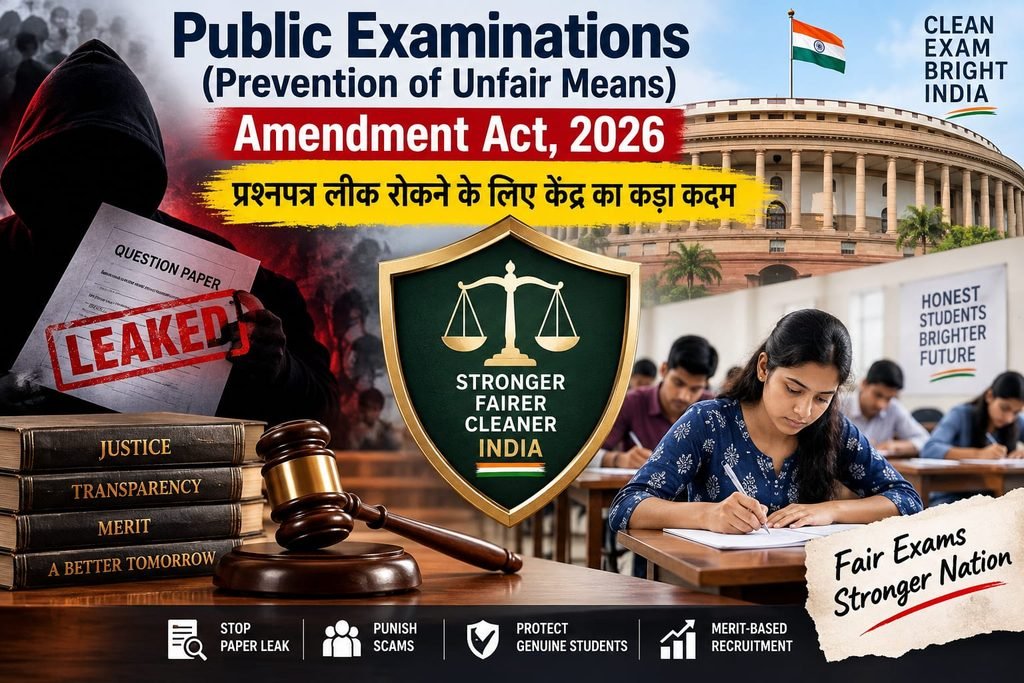
इसी चिंता को दूर करने के उद्देश्य से केंद्र सरकार ने Public Examinations (Prevention of Unfair Means) Amendment Act, 2026 के माध्यम से वर्ष 2024 में बनाए गए मौजूदा कानून को और अधिक सख्त एवं प्रभावी बनाया है।
“Public Examinations Act 2024 क्या है?”
Public Examinations (Prevention of Unfair Means) Act, 2024 भारत का एक कानून है, जिसका उद्देश्य सरकारी और सार्वजनिक परीक्षाओं में प्रश्नपत्र लीक, नकल, धोखाधड़ी और अन्य अनुचित साधनों को रोकना है। इस कानून में परीक्षा में गड़बड़ी करने वाले व्यक्तियों और संगठित गिरोहों के लिए सजा और जुर्माने का प्रावधान किया गया है।
संशोधन के मुख्य उद्देश्य
प्रश्नपत्र लीक और परीक्षाओं में अनुचित साधनों के इस्तेमाल को रोकना।
संगठित परीक्षा धोखाधड़ी करने वाले गिरोहों के खिलाफ कड़ी कार्रवाई करना।
ईमानदारी से परीक्षा देने वाले अभ्यर्थियों के हितों की रक्षा करना।
योग्यता और मेरिट के आधार पर भर्ती सुनिश्चित करना।
परीक्षा से जुड़ी सभी सूचनाओं और प्रक्रियाओं की सुरक्षा बढ़ाना।
परीक्षा आयोजित करने वाली सेवा प्रदाता संस्थाओं की जवाबदेही बढ़ाना।
तेज जांच और समयबद्ध न्याय सुनिश्चित करना।
सार्वजनिक परीक्षाओं के प्रति आम जनता का विश्वास बहाल करना।
संशोधित कानून में प्रमुख बदलाव
प्रावधान
2024 का कानून
2026 का संशोधन
व्यक्तिगत अपराधी (धारा 10)
3 से 5 वर्ष की कारावास और 10 लाख रुपये तक जुर्माना
5 से 10 वर्ष की कारावास और 50 लाख रुपये तक जुर्माना
सेवा प्रदाता संस्था (धारा 10)
1 करोड़ रुपये तक जुर्माना और 4 वर्ष के लिए परीक्षा संचालन पर प्रतिबंध
5 करोड़ रुपये तक जुर्माना और 8 वर्ष के लिए परीक्षा संचालन पर प्रतिबंध
निदेशक/उच्च पदस्थ प्रबंधन (धारा 10)
3 से 10 वर्ष की कारावास और 1 करोड़ रुपये जुर्माना
5 से 10 वर्ष की कारावास और 5 करोड़ रुपये जुर्माना
संगठित परीक्षा अपराध (धारा 11)
5 से 10 वर्ष की कारावास और न्यूनतम 1 करोड़ रुपये जुर्माना
7 से 10 वर्ष की कारावास और न्यूनतम 10 करोड़ रुपये जुर्माना
स्पेशल टास्क फोर्स (STF) की भूमिका
संशोधन के तहत केंद्र सरकार को स्पेशल टास्क फोर्स (STF) गठित करने की शक्ति दी गई है। इसका उद्देश्य सार्वजनिक परीक्षाओं में होने वाली संगठित धोखाधड़ी, प्रश्नपत्र लीक और अन्य गंभीर अपराधों की जांच को अधिक प्रभावी बनाना है।
दो महीने में जांच पूरी
परीक्षा से जुड़े अपराधों की जांच दो महीने के भीतर पूरी करने का प्रावधान किया गया है।
जिस पुलिस एजेंसी, केंद्रीय जांच एजेंसी या STF को मामले की जांच सौंपी जाएगी, उसे निर्धारित समय में जांच पूरी करनी होगी।
इससे जांच में अनावश्यक देरी को कम करने और मामलों को जल्द आगे बढ़ाने में मदद मिलेगी।
स्पेशल फास्ट ट्रैक कोर्ट
परीक्षा से जुड़े मामलों की जल्द सुनवाई और समयबद्ध न्याय सुनिश्चित करने के लिए स्पेशल फास्ट ट्रैक कोर्ट का प्रावधान किया गया है।
मामलों की सुनवाई दो दिनों के भीतर शुरू करनी होगी।
चार्जशीट दाखिल होने के बाद तीन महीने के भीतर न्यायिक प्रक्रिया पूरी करने का प्रावधान है।
लंबित मामलों को भी स्पेशल फास्ट ट्रैक कोर्ट में स्थानांतरित किया जा सकता है।
राज्यों और केंद्रशासित प्रदेशों को स्पेशल पब्लिक प्रॉसिक्यूटर नियुक्त करने होंगे।
संबंधित मामलों में BNS या अन्य कानूनों के तहत अपराधों की सुनवाई भी साथ में की जा सकेगी।
समयबद्ध अपील प्रक्रिया
इस संशोधन में अपील के लिए भी स्पष्ट और समयबद्ध प्रक्रिया निर्धारित की गई है।
स्पेशल फास्ट ट्रैक कोर्ट के फैसले, सजा या किसी अन्य आदेश के खिलाफ हाईकोर्ट में अपील दायर की जा सकेगी। इस अपील की सुनवाई दो न्यायाधीशों वाली पीठ (Two-Judge Bench) द्वारा की जाएगी।