Rivers of India: Himalayan and Peninsular River Systems, Origin, Tributaries and Important Facts of Competitive Government Exams(RRB,UPSC,STATE PSC,SSC ETC)

Geography | Indian Rivers | General Knowledge | Competitive Exams

Ganges river in Himalayas mountains

Assam Tee – Herkunft und Wiege des indischen Teeanbaus – Nibelungentee

Godavari

8

Introduction

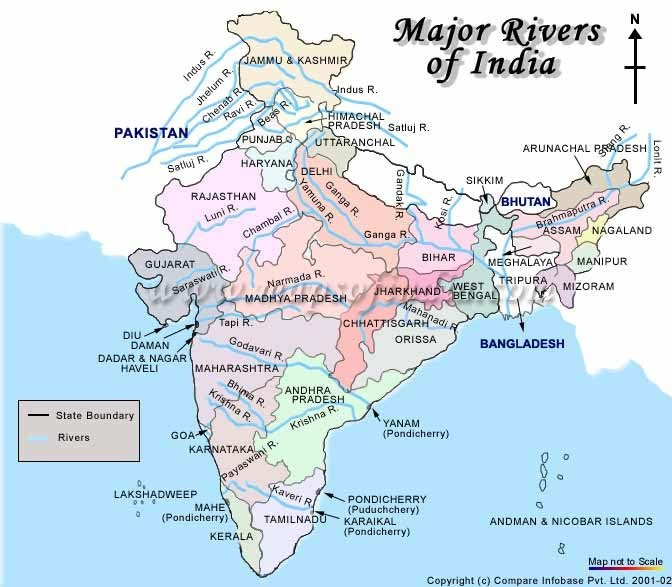
India is a land of diverse geographical features, including mountains, plateaus, plains, valleys and coastal regions. The rivers of India play a vital role in shaping the country’s geography, economy, agriculture and civilization.

Indian rivers provide water for irrigation, drinking, industries, hydroelectric power generation and transportation. They also support biodiversity and create fertile agricultural plains.

The rivers of India are broadly classified into two major groups:

  • Himalayan Rivers
  • Peninsular Rivers

Apart from these, some rivers form an inland drainage system and do not reach the sea.

In this article, we will explore the major river systems of India, their origin, tributaries, drainage patterns, important dams and geographical significance.

1. Classification of Indian Rivers

Indian rivers are classified mainly on the basis of their geographical origin and characteristics.

FeatureHimalayan RiversPeninsular Rivers
OriginHimalayas and adjoining highlandsPeninsular Plateau and Western Ghats
NatureMostly perennialMostly seasonal, with some important exceptions
Main source of waterGlaciers, snowmelt and rainfallMainly monsoon rainfall
River valleysDeep valleys and gorges in upper coursesBroad valleys and rocky courses
Drainage patternOften dendritic and antecedentCommonly dendritic and structurally influenced
Major riversIndus, Ganga, BrahmaputraGodavari, Krishna, Kaveri, Narmada, Tapi

Important Geography Fact: Himalayan rivers are generally perennial because they receive water from both rainfall and melting snow. Peninsular rivers depend more heavily on seasonal rainfall.

2. Himalayan River Systems

The Himalayan river system consists of three major river systems:

  1. The Indus River System
  2. The Ganga River System
  3. The Brahmaputra River System

These rivers originate in or near the Himalayan region and drain large areas of northern India.

Looking at India-Pak ties through prism of Indus Treaty: insights from a new book | Explained News – The Indian Express

National Mission for Clean Ganga

Map of Brahmaputra Basin. Source: Indian Institute of Technology,… | Download Scientific Diagram

A. The Indus River System
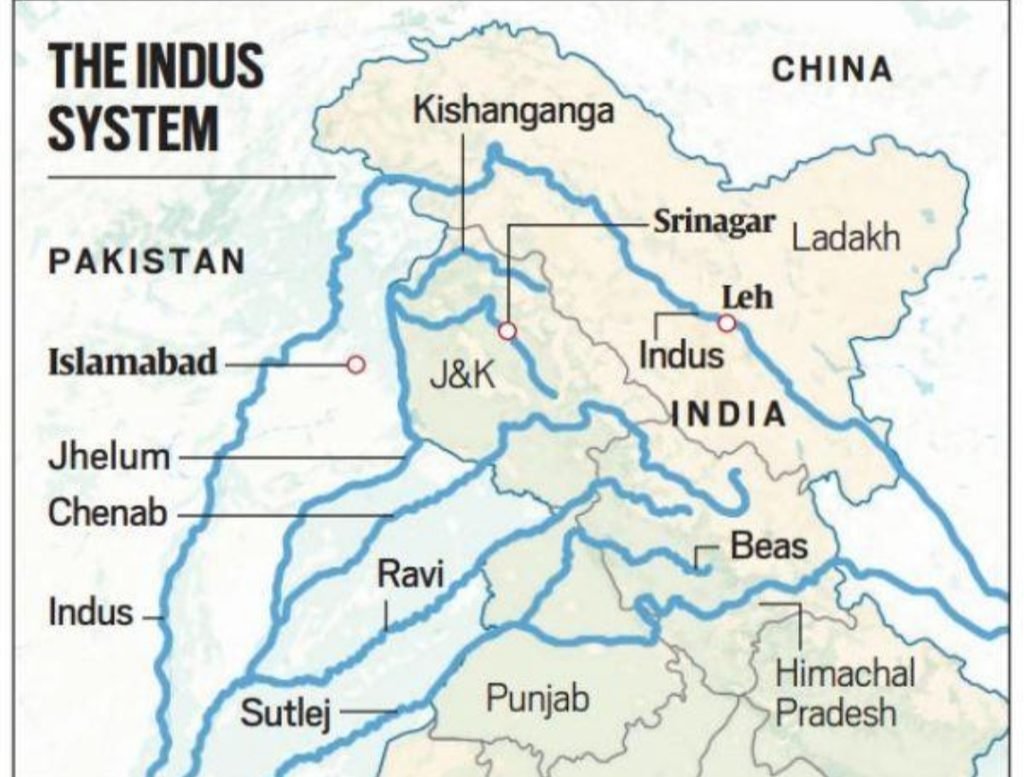
The Indus is one of the most important rivers of the Indian subcontinent.

Important Facts About the Indus River

  • Total length: Approximately 3,180 km.
  • Length in India: Approximately 709 km, according to the supplied textbook.
  • Origin: Near Bokhar Chu glacier in the Kailash Range of Tibet, close to Lake Mansarovar.
  • It is known as Singi Khabban in Tibet.
  • It flows through Tibet, India and Pakistan.
  • It ultimately drains into the Arabian Sea.

Major Tributaries of the Indus

TributaryApproximate Length
Jhelum725 km
Chenab1,800 km
Ravi720 km
Beas470 km
Sutlej1,050 km

These rivers are commonly associated with the Punjab region, whose name is historically linked with the five rivers.

Origin of Important Tributaries

RiverSource
JhelumVerinag, Kashmir
ChenabBara Lacha Pass, Himachal Pradesh
RaviNear Rohtang Pass, Himachal Pradesh
BeasNear Rohtang Pass, Himachal Pradesh
SutlejNear Lake Mansarovar, Tibet

Indus Water Treaty

  • The Indus Water Treaty was signed between India and Pakistan in 1960.
  • It regulates the use of the waters of the Indus river system.
  • The eastern rivers are Ravi, Beas and Sutlej.
  • The western rivers are Indus, Jhelum and Chenab.
  • Under the treaty’s original allocation framework, India has unrestricted use of the eastern rivers, while the western rivers are primarily allocated to Pakistan, subject to specified uses permitted to India.

Important Projects on the Indus River System

  • Kishanganga Project
  • Tulbul Project
  • Baglihar Project

These projects are associated with hydropower generation and water management.

B. The Ganga River System
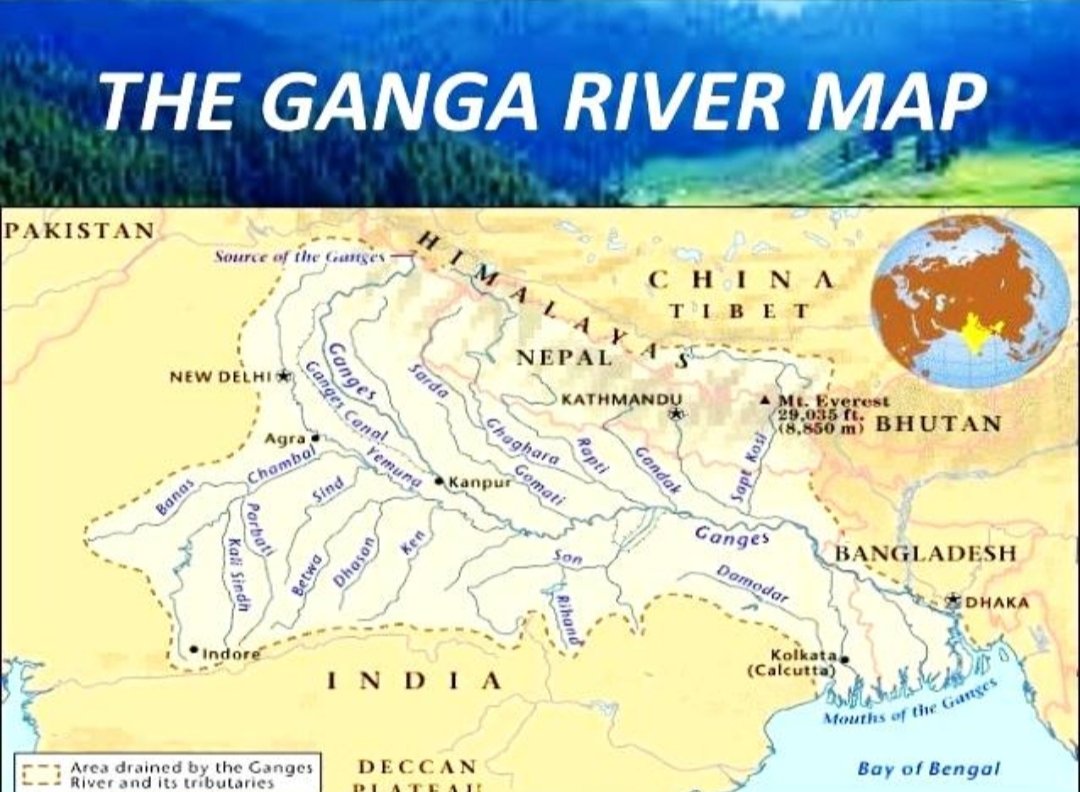
The Ganga is one of the most important rivers in India. It is known for its religious, cultural, agricultural and geographical significance.

mountain river flowing in a deep canyon

India, Uttar Pradesh, Varanasi,

8

Important Facts About the Ganga

  • Total length: Approximately 2,525 km.
  • It originates in the Himalayan region of Uttarakhand.
  • The headstream of the Ganga is formed by the Bhagirathi and Alaknanda rivers.
  • The Bhagirathi originates from the Gangotri Glacier near Gaumukh.
  • The Alaknanda originates from the Satopanth Glacier region.
  • The two rivers meet at Devprayag, where the combined river is called the Ganga.
  • The Ganga flows through Uttarakhand, Uttar Pradesh, Bihar, Jharkhand and West Bengal.
  • It ultimately drains into the Bay of Bengal through the Ganga-Brahmaputra delta.

The Five Important Prayags

The confluences of important Himalayan rivers in Uttarakhand are known as Prayags.
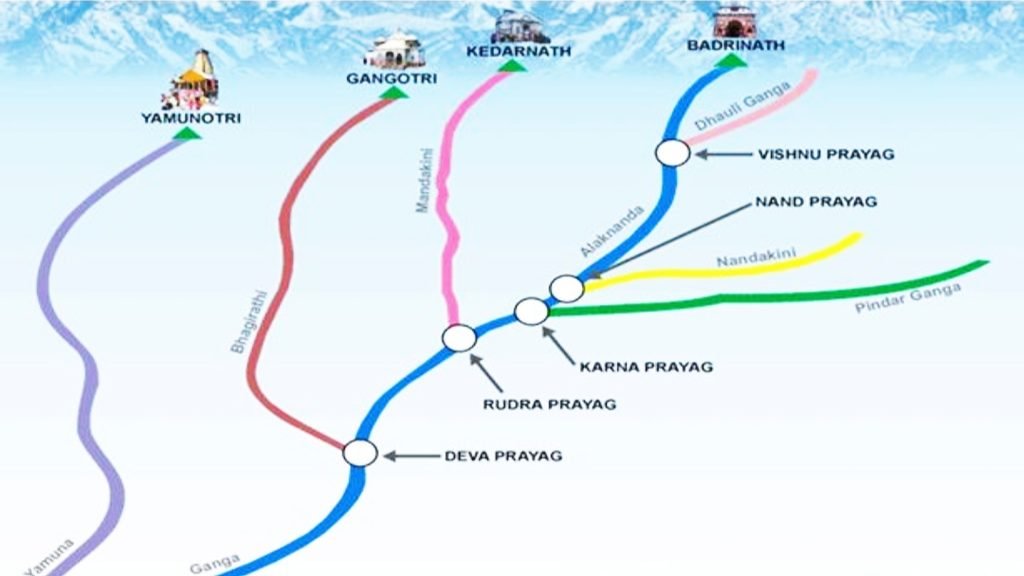
PrayagRivers Meeting
VishnuprayagAlaknanda + Dhauliganga
NandaprayagAlaknanda + Nandakini
KarnaprayagAlaknanda + Pindar
RudraprayagAlaknanda + Mandakini
DevprayagAlaknanda + Bhagirathi

Correct sequence of the five Prayags:

Vishnuprayag → Nandaprayag → Karnaprayag → Rudraprayag → Devprayag

Ganga River Flow Diagram

Gangotri Glacier

Origin of the Bhagirathi

Bhagirathi + Alaknanda

Meet at Devprayag

Ganga

Flows through the northern plains

Ganga-Brahmaputra Delta

Bay of Bengal

Major Tributaries of the Ganga

The Ganga has numerous tributaries that contribute to its enormous drainage basin.

TributaryImportant Fact
YamunaMajor right-bank tributary
GhagharaImportant Himalayan tributary
GandakMajor tributary from Nepal
KosiKnown as the Sorrow of Bihar
SonImportant tributary from the south
GomtiImportant tributary of the Ganga
DamodarKnown as the Sorrow of Bengal

Yamuna River

  • Approximate length: 1,375 km.
  • Origin: Yamunotri Glacier in Uttarakhand.
  • It flows approximately parallel to the Ganga for a considerable distance.
  • It joins the Ganga at Prayagraj (Allahabad).
  • Major tributaries include Chambal, Sind, Betwa and Ken.
  • The Chambal is an important tributary of the Yamuna.

The Ganga Delta

  • The combined Ganga-Brahmaputra river system forms the world’s largest delta.
  • The delta is known as the Sundarbans.
  • It covers a vast region of India and Bangladesh.
  • The delta is famous for mangrove forests and rich biodiversity.

Ganga in West Bengal

  • The Bhagirathi-Hooghly is an important distributary system of the Ganga in West Bengal.
  • The Hooghly flows through Kolkata and eventually reaches the Bay of Bengal.
  • The Farakka Barrage is an important water-management structure on the Ganga in West Bengal.
  • It helps divert water towards the Hooghly to support navigation and manage sediment deposition.

C. The Brahmaputra River System

The Brahmaputra is one of the major Himalayan river systems. It is known for its enormous water discharge, wide floodplains and extensive drainage basin.

Could Dhaka-Beijing River Cooperation Be Solution for Bangladesh’s Good River Water Governance? | The Asian Age Online, Bangladesh

The world’s biggest hydropower project breaks ground in Tibet

Navayuga Engineering Company Ltd.

8

Important Facts About the Brahmaputra

  • Total length: Approximately 2,900 km.
  • Length in India: Approximately 885 km.
  • Origin: Chemayungdung Glacier region in Tibet.
  • It is known as the Yarlung Tsangpo in Tibet.
  • It enters India through Arunachal Pradesh, where it is known as the Dihang or Siang.
  • It takes a major U-turn near Namcha Barwa.
  • It flows through Assam and enters Bangladesh.
  • In Bangladesh, the Brahmaputra is commonly known as the Jamuna.
  • The Ganga is known as the Padma in Bangladesh.
  • The Meghna is another major river system that joins the combined river system before it enters the Bay of Bengal.

Important Tributaries of the Brahmaputra

  • Subansiri
  • Kameng
  • Dhansiri
  • Manas
  • Dibang
  • Lohit
  • Teesta

Brahmaputra River Flow Diagram

Chemayungdung Glacier

Tibet — Yarlung Tsangpo

Namcha Barwa

Major U-turn in the river course

Dihang / Siang

Arunachal Pradesh

Brahmaputra

Assam → Bangladesh (Jamuna)

Bay of Bengal

Through the Ganga-Brahmaputra-Meghna system

Majuli Island

  • Majuli is a river island in Assam.
  • It is located in the Brahmaputra River.
  • It is famous for its cultural heritage and riverine landscape.
  • Its size and shape are affected by river erosion and sediment deposition.

3. Peninsular Rivers of India

Peninsular rivers originate mainly from the Peninsular Plateau and the Western Ghats.

Important Characteristics

  • Most Peninsular rivers depend heavily on monsoon rainfall.
  • Their flow is generally more seasonal than that of Himalayan rivers.
  • Many rivers flow from west to east.
  • Most east-flowing rivers form deltas near their mouths.
  • The Narmada and Tapi are major west-flowing rivers.
  • Many Peninsular rivers follow the general slope of the plateau.

Peninsular rivers can be divided into two groups:

  1. East-flowing rivers
  2. West-flowing rivers

A. East-Flowing Rivers

These rivers generally drain into the Bay of Bengal.

Mahanadi River Delta by Planetobserver / Science Photo Library

Andhra Pradesh: India’s unknown backwaters destination | Rough Guides

Krishna River Gorge near Srisailam, Andhra Pradesh, India

9

Major East-Flowing Rivers

RiverApproximate LengthOriginImportant Fact
Mahanadi858 kmChhattisgarhForms a delta in Odisha
Godavari1,465 kmNashik, MaharashtraLongest Peninsular river
Krishna1,327 kmNear MahabaleshwarMajor east-flowing river
Kaveri805 kmBrahmagiri HillsImportant river of southern India
Pennar597 kmNandi Hills regionFlows through Karnataka and Andhra Pradesh

1. Mahanadi River

  • Approximate length: 858 km.
  • Origin: Dhamtari district, Chhattisgarh.
  • It flows through Chhattisgarh and Odisha.
  • It drains into the Bay of Bengal.
  • Important tributaries include Ib, Seonath, Hasdeo, Mand and Jonk.
  • The Hirakud Dam is an important multipurpose project on the Mahanadi.

2. Godavari River

  • Approximate length: 1,465 km.
  • Origin: Trimbakeshwar near Nashik, Maharashtra.
  • It is the longest Peninsular river of India.
  • It is also known as the Dakshina Ganga or Ganga of the South.
  • It flows into the Bay of Bengal.
  • Major tributaries include Manjira, Penganga, Wardha, Wainganga, Indravati, Sabari and Pranhita.

Important Fact: Godavari has the second-largest river basin in India after the Ganga basin.

3. Krishna River

  • Approximate length: 1,327 km.
  • Origin: Near Mahabaleshwar in the Western Ghats.
  • It flows through Maharashtra, Karnataka, Telangana and Andhra Pradesh.
  • It drains into the Bay of Bengal.
  • Major tributaries include Koyna, Dudhaganga, Panchganga, Malaprabha, Ghataprabha, Bhima, Tungabhadra and Musi.

4. Pennar River

  • Approximate length: 597 km.
  • Also known as Penneru or North Pinakini.
  • Origin: Nandi Hills region of Karnataka.
  • It flows through Karnataka and Andhra Pradesh.
  • It drains into the Bay of Bengal.

5. Kaveri River

  • Approximate length: 805 km.
  • Origin: Brahmagiri Hills in the Western Ghats.
  • It flows through Karnataka and Tamil Nadu.
  • It is an important source of irrigation and water supply in southern India.
  • Major tributaries include Hemavati, Amaravati, Bhavani, Kabini, Lakshmana Tirtha and Shimsha.
  • It is one of the most important rivers of southern India.

Important Fact: The Kaveri is one of the major Peninsular rivers that maintains a relatively sustained flow throughout much of the year.

B. West-Flowing Rivers

West-flowing rivers generally drain into the Arabian Sea.

File:A view of Marble Rocks, Jabalpur Madhya Pradesh India.jpg – Wikimedia Commons

File:Tapti River, Cable bridge, Surat.jpg – Wikimedia Commons

Jog Falls

Major West-Flowing Rivers

RiverApproximate LengthOriginImportant Fact
Narmada1,057 kmAmarkantak PlateauFlows through a rift valley
Tapi724 kmSatpura RangeAlso known as Tapti
Sabarmati416 kmAravalli RangeFlows through Gujarat
Mahi560 kmVindhya RangeCrosses the Tropic of Cancer twice
Luni450 kmAravalli RangeInland drainage river

1. Narmada River

  • Approximate length: 1,057 km.
  • Origin: Amarkantak Plateau in Madhya Pradesh.
  • It flows westward through a rift valley.
  • It drains into the Gulf of Khambhat in the Arabian Sea.
  • The famous Dhuandhar Falls is located on the Narmada River near Jabalpur.
  • Marble Rocks at Bhedaghat are another major attraction.
  • Important tributaries include Hiran, Burhner, Banjar, Shar, Shakkar, Tawa and Kolar.

2. Tapi River

  • Approximate length: 724 km.
  • Origin: Satpura Range near Multai in Madhya Pradesh.
  • It flows through Madhya Pradesh, Maharashtra and Gujarat.
  • It drains into the Arabian Sea.
  • It follows a rift valley.
  • Important tributaries include Purna, Betul, Arunavati and Ganjal.

3. Sabarmati River

  • Approximate length: 416 km.
  • Origin: Aravalli Range.
  • It flows through Rajasthan and Gujarat.
  • It drains into the Gulf of Khambhat.

4. Mahi River

  • Approximate length: 560 km.
  • Origin: Vindhya Range in Madhya Pradesh.
  • It flows through Madhya Pradesh, Rajasthan and Gujarat.
  • It crosses the Tropic of Cancer twice.

5. Luni River

  • Approximate length: 450 km.
  • Origin: Aravalli Range.
  • It is also known as the Salt River.
  • It flows through the arid region of Rajasthan.
  • It eventually disappears into the marshy region of the Rann of Kutch.

West-Flowing River Diagram

Amarkantak Plateau

Origin of Narmada

Narmada Rift Valley

Flows westward through central India

Gulf of Khambhat

Arabian Sea

4. Important Drainage Patterns of Indian Rivers

A drainage pattern describes the arrangement of a river and its tributaries.

Major Types of Drainage Patterns

Drainage PatternDescriptionExample
DendriticResembles the branches of a treeGanga River system
TrellisTributaries join the main river at approximately right anglesStructurally controlled regions
RadialRivers flow outward from a central elevated areaAmarkantak region
CentripetalRivers flow towards a central basinInland drainage regions
RectangularRivers follow joints and faults, creating right-angle bendsFaulted regions

Antecedent and Consequent Rivers

Antecedent Rivers

  • These rivers existed before the uplift of the surrounding mountains.
  • They maintained their courses while the land was uplifted.
  • They often cut deep gorges through mountain ranges.
  • Important examples include the Indus, Sutlej and Brahmaputra.

Consequent Rivers

  • These rivers follow the general slope of the land.
  • Many Peninsular rivers are consequent rivers.
  • Examples include Godavari, Krishna and Kaveri.

5. Inland Drainage System of India

Some rivers of India do not reach the sea. These rivers form an inland drainage system.

Important Facts

  • Inland drainage occurs mainly in arid and semi-arid regions.
  • Rivers may disappear into desert sands or terminate in inland lakes.
  • The Ghaggar is an important example of a seasonal inland drainage river.
  • It flows through the lower Himalayan slopes and the plains of northwestern India.
  • The Luni River is another example of a river that does not reach the open sea.

Ghaggar River

  • Approximate length: 494 km, as mentioned in the supplied textbook.
  • It is a seasonal river.
  • It originates in the Shivalik region.
  • It flows through Haryana and Rajasthan.
  • Its water is lost in the dry sands of the Rajasthan region.
  • It is associated with the ancient Saraswati tradition.

6. Important Dams and River Projects in India

Dams and river projects are important for irrigation, flood control, drinking water supply, navigation and hydroelectric power generation.

Dam / ProjectRiverState / Region
Farakka BarrageGangaWest Bengal
Hirakud DamMahanadiOdisha
Bhakra-Nangal DamSutlejHimachal Pradesh / Punjab region
Baglihar DamChenabJammu and Kashmir
Kishanganga ProjectKishangangaJammu and Kashmir
Sardar Sarovar DamNarmadaGujarat
Tehri DamBhagirathiUttarakhand
Rihand DamRihandUttar Pradesh

Farakka Barrage

  • Located in West Bengal.
  • Built across the Ganga River.
  • Its construction was completed in 1975.
  • It diverts water towards the Hooghly River.
  • It supports the maintenance of navigability in the Hooghly system.

Hirakud Dam

  • Located on the Mahanadi River in Odisha.
  • It is one of the major multipurpose river valley projects in India.
  • It supports irrigation, flood management and hydroelectric power generation.

7. Important Rivers, Waterfalls and Lakes

India’s rivers are associated with numerous waterfalls, lakes, river islands and unique geographical features.

Important Waterfalls

WaterfallRiver / LocationImportant Fact
Dhuandhar FallsNarmada, Madhya PradeshLocated near Marble Rocks
Jog FallsSharavathi, KarnatakaMajor waterfall in the Western Ghats
Kunchikal FallsKarnatakaAssociated with the Varahi River
Nohkalikai FallsMeghalayaFamous plunge waterfall near Cherrapunji
Shivanasamudra FallsKaveri, KarnatakaImportant hydroelectric power location

Important River-Related Lakes and Features

NameLocationKey Fact
Wular LakeJammu and KashmirOne of India’s largest freshwater lakes
Chilika LakeOdishaBrackish water lagoon
Loktak LakeManipurFamous for floating phumdis
Purbasthali LakeWest BengalOxbow lake associated with the Ganga
Dhal LakeSrinagarFamous for its scenic landscape
Sambhar LakeRajasthanImportant inland salt lake
Lonar LakeMaharashtraMeteorite-impact crater lake

8. Important Geography Facts for Competitive Exams

The following points are particularly useful for examinations such as RRB NTPC, SSC, UPSC, state-level exams and other General Knowledge tests.

  • The Indus, Ganga and Brahmaputra are the three major Himalayan river systems.
  • The Ganga is one of the most important river systems in India.
  • The Godavari is the longest Peninsular river of India.
  • The Ganga-Brahmaputra system forms the world’s largest delta.
  • The Sundarbans is famous for its mangrove ecosystem.
  • The Narmada and Tapi are major west-flowing Peninsular rivers.
  • The Narmada flows through a rift valley.
  • The Mahi River crosses the Tropic of Cancer twice.
  • The Kosi is known as the Sorrow of Bihar.
  • The Damodar is known as the Sorrow of Bengal.
  • The Brahmaputra is known as the Yarlung Tsangpo in Tibet.
  • The Brahmaputra is known as the Jamuna in Bangladesh.
  • The Ganga is known as the Padma in Bangladesh.
  • The Bhagirathi and Alaknanda meet at Devprayag.
  • Majuli is a famous river island in Assam.
  • The Farakka Barrage is located on the Ganga in West Bengal.
  • The Hirakud Dam is built on the Mahanadi River.
  • The Narmada River flows into the Gulf of Khambhat.
  • The Luni River is associated with inland drainage.

9. Quick Revision Table: Indian Rivers

RiverOriginFlows Into
IndusTibetan PlateauArabian Sea
GangaDevprayagBay of Bengal
YamunaYamunotri GlacierGanga
BrahmaputraTibetBay of Bengal
MahanadiChhattisgarhBay of Bengal
GodavariMaharashtraBay of Bengal
KrishnaWestern GhatsBay of Bengal
KaveriBrahmagiri HillsBay of Bengal
NarmadaAmarkantak PlateauArabian Sea
TapiSatpura RangeArabian Sea
SabarmatiAravalli RangeGulf of Khambhat
LuniAravalli RangeRann of Kutch region

10. Frequently Asked Questions (FAQs)

Q1. How many major river systems are there in India?

India has two broad river groups: Himalayan rivers and Peninsular rivers. The three major Himalayan river systems are the Indus, Ganga and Brahmaputra.

Q2. Which is the longest Peninsular river in India?

The Godavari is the longest Peninsular river in India, with an approximate length of 1,465 km.

Q3. Which river is known as the Dakshina Ganga?

The Godavari River is known as the Dakshina Ganga or Ganga of the South.

Q4. Which river is known as the Sorrow of Bihar?

The Kosi River is known as the Sorrow of Bihar because of its historical flood problems.

Q5. Which river is known as the Sorrow of Bengal?

The Damodar River is historically known as the Sorrow of Bengal because of its destructive floods.

Q6. Which rivers form the Ganga?

The Bhagirathi and Alaknanda meet at Devprayag to form the Ganga.

Q7. Which is the largest delta in the world?

The Ganga-Brahmaputra-Meghna delta, commonly known as the Sundarbans Delta, is the world’s largest delta.

Q8. Which major rivers flow westward in India?

The Narmada and Tapi are the major west-flowing Peninsular rivers.

Q9. Which river crosses the Tropic of Cancer twice?

The Mahi River crosses the Tropic of Cancer twice.

Q10. Which river is associated with Majuli Island?

Majuli Island is located in the Brahmaputra River in Assam.

Conclusion

The rivers of India are essential to the country’s geographical, economic and cultural development. They support agriculture, provide drinking water, generate electricity and sustain diverse ecosystems.

Understanding the Himalayan and Peninsular river systems helps us understand India’s drainage patterns, physical geography and regional development.

For competitive examinations, it is particularly important to remember the origin, length, tributaries, direction of flow and drainage basin of major Indian rivers.

A systematic study of these river systems makes Indian Geography easier to underderstand and helps students revise important facts more effectively.

People Also Read

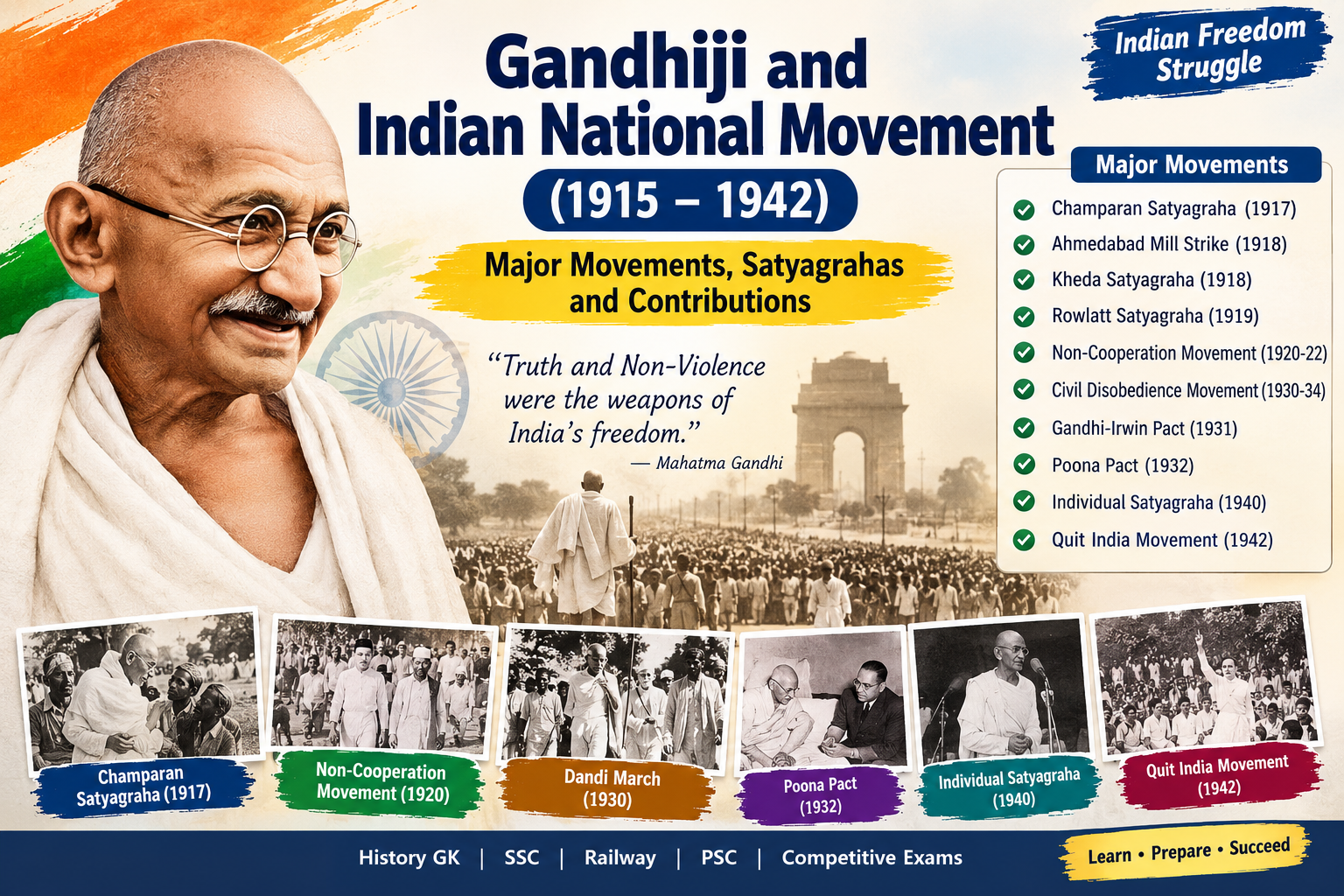
Gandhiji and Indian National Movement (1915-1942)

Gandhiji and Indian National Movement 1915-1942 | History GK

Olympic Games History: Host Cities, India’s Medal Winners & Important Facts

Olympic Games History, Host Cities & India Medal Winners

Important Inventions, Discoveries and Inventors: Complete GK List for Competitive Exams

Important Inventions and Inventors: List, Year, Country & Discoveries

BRICS Summit 2026: A Comprehensive Guide to Its Global Impact, Agenda and What Comes Next

BRICS Summit 2026: India, New Delhi Declaration, Members and Key Highlights
Current Afairs for Competitive Exams in Hindi : 2026 – 2027

Current Afairs for Competitive Exams in Hindi : 2026 – 2027

Gandhiji and Indian National Movement (1915-1942)

Gandhiji and Indian National Movement (1915-1942)

Introduction

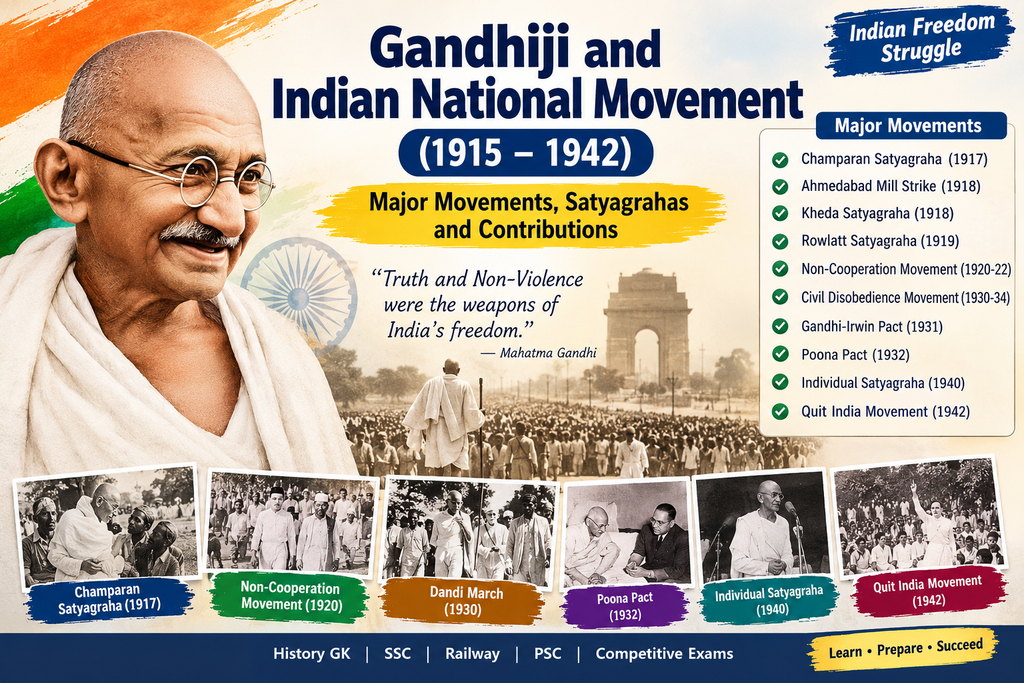
Gandhiji and Indian National Movement is one of the most important topics in Modern Indian History. Mahatma Gandhi transformed India’s freedom struggle into a mass movement based on the principles of Truth (Satya) and Non-Violence (Ahimsa). After returning from South Africa in 1915, Gandhi led several movements against British rule and inspired millions of Indians to participate in the struggle for independence.

From the Champaran Satyagraha of 1917 to the Quit India Movement of 1942, Gandhi played a central role in shaping India’s national movement. This article discusses the major events, movements and contributions of Mahatma Gandhi in chronological order.

https://culture.gov.in/mahatma-gandhi

Gandhiji’s Emergence

  • Mahatma Gandhi was born on 2 October 1869 at Porbandar, Gujarat.
  • His father was Karamchand Uttamchand Gandhi, and his mother was Putlibai.
  • Gandhiji was a vegetarian and belonged to a Jain-influenced merchant community.
  • He qualified as a Barrister in England and returned to India in 1891. In 1892, he went to South Africa.
  • On 9 January 1915, he returned to India. Pravasi Bharatiya Divas is celebrated every year on this day.
  • Natal, South Africa, was the main centre of Gandhiji’s activities during his early years there.
  • Gandhiji’s autobiography is “My Experiments with Truth”, originally written in Gujarati. It was translated into English by Mahadev Desai.
  • In 1909, Gandhiji wrote “Hind Swaraj” (Indian Home Rule) while travelling from England to South Africa. In Hind Swaraj, Gandhi stated that the real enemy was not British political domination alone, but modern industrial civilization as a whole.
  • Gandhiji wrote for the “Indian Opinion” from 1903 to 1915 while he was in South Africa.
  • In Indulal Yajnik’s “Young India”, Gandhiji wrote from 1919 to 1931, during the Khilafat and Non-Cooperation movements.
  • Gandhiji’s favourite devotional song was “Vaishnava Jana To”, written by Narsinh Mehta.
  • From 1933, Gandhiji wrote in the journal “Harijan” during the Civil Disobedience Movement. The publication of “Navajivan” began again on 1 November 1947 with Gandhiji’s blessings.
  • In 1894, Gandhiji founded the Natal Indian National Congress (NINC) in South Africa.
  • Gandhiji’s two important principles were “Satyagraha” and “Ahimsa.” Satyagraha means a firm commitment to truth.
  • Gandhiji developed the concept of Satyagraha from John Ruskin’s book “Unto This Last.”
  • He adopted the principle of Ahimsa (non-violence) from Leo Tolstoy’s book “The Kingdom of God is Within You.”
  • The Indian Relief Act (1914) was the result of discussions between Gandhiji and General Jan Christiaan Smuts, a leading figure in the South African government.
  • Rabindranath Tagore addressed Gandhiji as “Mahatma.” Netaji Subhas Chandra Bose referred to him as the “Father of the Nation.”
  • Gandhiji’s political guru was Gopal Krishna Gokhale.
  • Gandhiji’s first major public appearance in India was at the opening ceremony of Banaras Hindu University (BHU) in February 1916.

Major Movements Lead by Gandhi

1. Champaran Satyagraha (1917)

The first successful Satyagraha in India was launched in Champaran, Bihar.

Causes

  • Peasants were forced to cultivate indigo under the oppressive Tinkathia system.
  • Local leader Raj Kumar Shukla requested Gandhi to visit Champaran.

Result

  • Gandhi investigated the grievances of peasants.
  • The British government accepted several demands.
  • It became Gandhi’s first major victory in India.

Important Leaders

  • Raj Kumar Shukla
  • Rajendra Prasad
  • J. B. Kripalani
  • Mahadev Desai

2. Ahmedabad Mill Strike (1918)

This movement was related to the rights of textile mill workers.

Causes

  • Workers demanded higher wages.

Gandhi’s Role

  • Gandhi supported the workers.
  • He went on a fast to press their demands.

Result

  • Workers received increased allowances and wages.

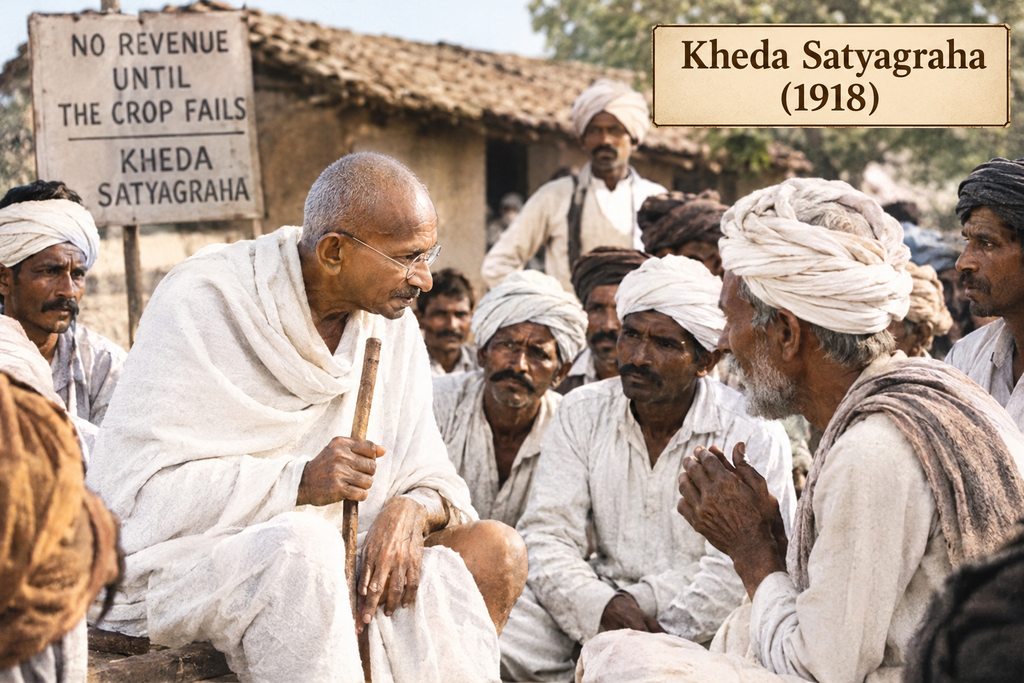
3. Kheda Satyagraha (1918)

This movement was launched in Gujarat.

Causes

  • Crop failure caused severe hardship for farmers.
  • Farmers demanded suspension of land revenue collection.

Leaders

  • Sardar Vallabhbhai Patel
  • Indulal Yagnik

Result

  • Revenue collection was suspended for affected peasants.

4. Rowlatt Satyagraha (1919)

The British government passed the Rowlatt Act, allowing detention without trial.

Gandhi’s Response

  • Gandhi called for a nationwide protest.
  • A countrywide strike was observed on 6 April 1919.

Jallianwala Bagh Tragedy

On 13 April 1919, British troops opened fire on a peaceful gathering at Jallianwala Bagh, Amritsar.

Result

  • Gandhi withdrew the movement.
  • He later called it a “Himalayan Blunder.”

5. Non-Cooperation Movement (1920-1922)

The Non-Cooperation Movement was launched on 1 August 1920.

Objectives

  • Boycott British institutions.
  • Boycott foreign goods.
  • Promote Swadeshi.

Impact

Millions of Indians participated in the movement.

Withdrawal

After the Chauri Chaura incident, Gandhi withdrew the movement in 1922.

He was arrested on 10 March 1922 and sentenced to six years’ imprisonment.


6. Civil Disobedience Movement (1930-1934)

The Civil Disobedience Movement marked a new phase in the freedom struggle.

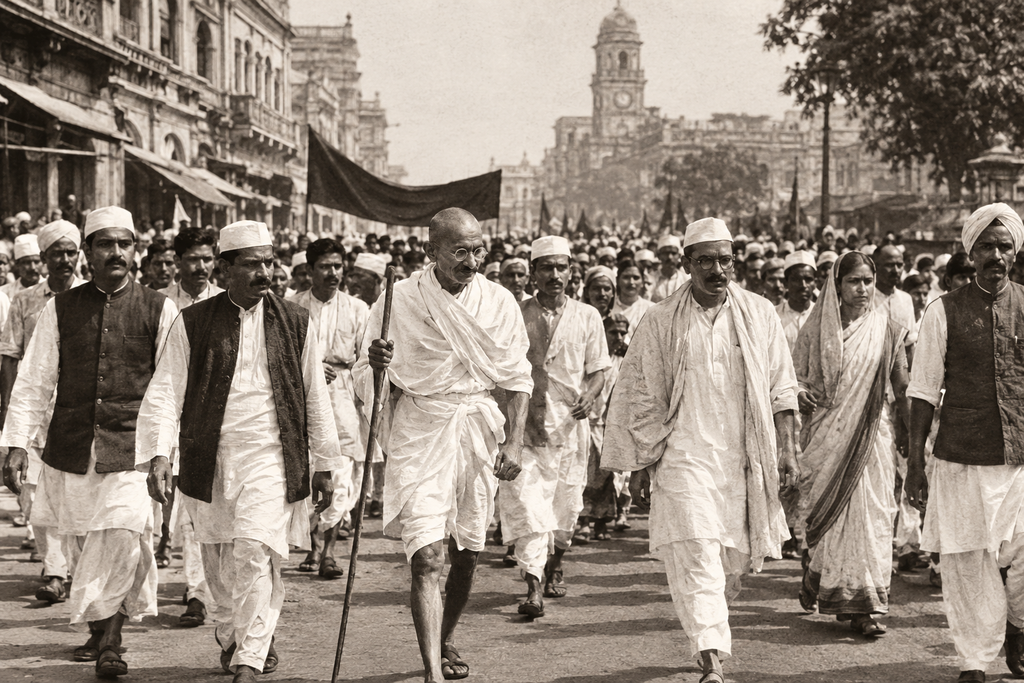
Salt Satyagraha (Dandi March)

On 6 April 1930, Gandhi broke the Salt Law at Dandi.

This event became a symbol of resistance against British rule.

First Round Table Conference

The Indian National Congress boycotted the First Round Table Conference.


Gandhi-Irwin Pact (1931)

On 5 March 1931, Gandhi and Lord Irwin signed the Gandhi-Irwin Pact.

Main Outcome

  • Gandhi agreed to suspend the Civil Disobedience Movement.
  • Congress agreed to participate in the Second Round Table Conference.

Second Round Table Conference (1931)

Gandhi attended the conference as the representative of the Indian National Congress.

However, the conference failed to achieve a satisfactory political settlement.


Communal Award (1932)

In August 1932, British Prime Minister Ramsay MacDonald announced the Communal Award.

Features

  • Separate representation for various communities.
  • Led to political controversy across India.

Gandhi opposed certain provisions and began a fast in Yerwada Jail.


Poona Pact (1932)

The Poona Pact was signed between:

  • Mahatma Gandhi
  • Dr. B. R. Ambedkar

Significance

  • Resolved the dispute over separate electorates.
  • Increased reserved seats for the Depressed Classes within a joint electorate system.

Second Phase of Civil Disobedience Movement (1932-1934)

After returning from the Second Round Table Conference, Gandhi resumed the movement.

Important Developments

  • Movement restarted on 3 January 1932.
  • Gandhi increasingly focused on the upliftment of Harijans (Dalits).
  • The movement was finally withdrawn in 1934.

7. Individual Satyagraha (1940)

In 1940, Congress authorized Gandhi to launch a limited movement against British policies.

First Individual Satyagrahi

Vinoba Bhave became the first Individual Satyagrahi on 17 October 1940.

Second Individual Satyagrahi

Jawaharlal Nehru became the second Individual Satyagrahi on 31 October 1940.


8. Quit India Movement (1942)

The Quit India Movement was launched on 9 August 1942.

Background

  • Failure of the Cripps Mission.
  • Growing demand for complete independence.

Features

  • Mass participation across India.
  • Famous slogan: “Do or Die”

Significance

The movement demonstrated the determination of Indians to end British rule and paved the way for independence.


Conclusion

The story of Gandhiji and Indian National Movement is the story of India’s struggle for freedom through truth, non-violence and mass participation. From Champaran Satyagraha to the Quit India Movement, Gandhi transformed the national movement into a people’s movement. His leadership, moral courage and commitment to justice continue to inspire generations and remain an important part of India’s history.

People also read

Olympic Games History: Host Cities, India’s Medal Winners & Important Facts

Olympic Games History, Host Cities & India Medal Winners

Important Inventions, Discoveries and Inventors: Complete GK List for Competitive Exams

Important Inventions and Inventors: List, Year, Country & Discoveries

Current Afairs for Competitive Exams in Hindi : 2026 – 2027

Current Afairs for Competitive Exams in Hindi : 2026 – 2027

BRICS Summit 2026: A Comprehensive Guide to Its Global Impact, Agenda and What Comes Next

BRICS Summit 2026: India, New Delhi Declaration, Members and Key Highlights
जनगणना 2027: भारत की प्रथम डिजिटल जनगणना

जनगणना 2027: भारत की प्रथम डिजिटल जनगणना Explained

Public Examinations (Prevention of Unfair Means) Amendment Act 2026: क्या बदला, नई सजा, जुर्माना और प्रमुख प्रावधान

Public Examinations (Prevention of Unfair Means) Amendment Act 2026:

Commonwealth Games 2026: India Medal Winners, Medal Tally and Important Facts

Commonwealth Games 2026: India Medal Winners, Medal Tally

Indian Classical, Folk and Tribal Dances: Complete List, States, History and Famous Dancers

Indian Classical, Folk and Tribal Dances: Complete List, States, History and Famous Dancers – Job Express Online

Olympic Games History: Host Cities, India’s Medal Winners & Important Facts

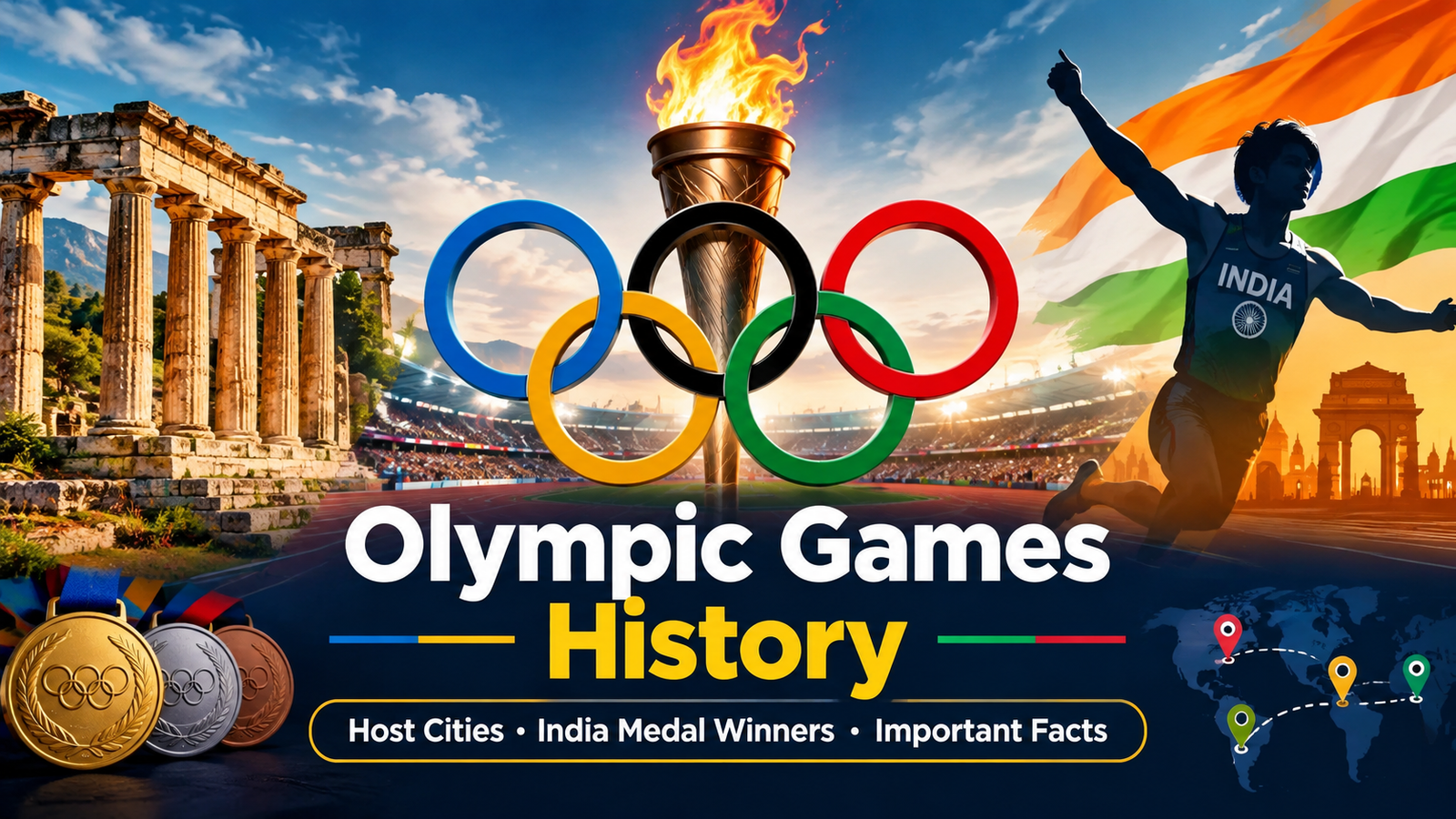
Olympic Games History dates back to the ancient Olympic Games held in Olympia, Greece. The modern Olympic Games were revived in 1896 in Athens under the leadership of Pierre de Coubertin and have since become a major international sporting event.

In this article, we will explore the Olympic Games History, including the ancient and modern Olympics, important milestones, host countries, India’s medal winners and key facts useful for competitive exams and general knowledge.

Ancient vs. Modern Origins

  • Ancient Olympics: The ancient games trace back to 776 BC in Olympia, Greece, celebrated as a religious and athletic festival in honor of Zeus.
  • Modern Olympics: After centuries of dormancy, the first Modern Summer Olympic Games were inaugurated in 1896 in Athens, Greece.

The Father of the Modern Olympics

  • French educator and historian Baron Pierre de Coubertin is revered as the Father of the Modern Olympic Games. He established the International Olympic Committee (IOC) in 1894 to foster global peace through athletic competition.

The Olympic Symbol & Rings

  • The Olympic Flag made its debut at the 1920 Antwerp Games.
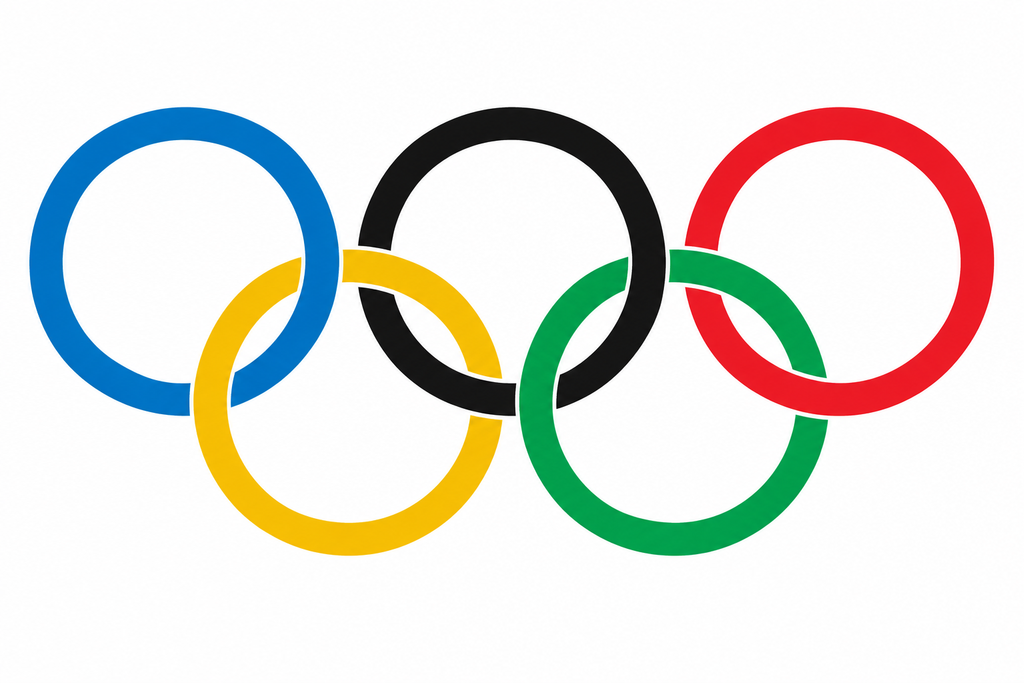
  • The five interlaced rings on a white backdrop represent the union of five inhabited continents and the meeting of athletes worldwide:
    • Blue: Europe
    • Yellow: Asia
    • Black: Africa
    • Green: Oceania / Australia
    • Red: Americas

Olympic Motto & Flame

  • Olympic Motto: Citius, Altius, Fortius (Latin for “Faster, Higher, Stronger”).
  • Olympic Flame (Sacred Fire): The modern tradition of the Olympic Flame was reintroduced during the 1928 Amsterdam Olympic Games, followed by the iconic Olympic Torch Relay starting from the 1936 Berlin Games.

https://www.olympics.com/en/olympic-games

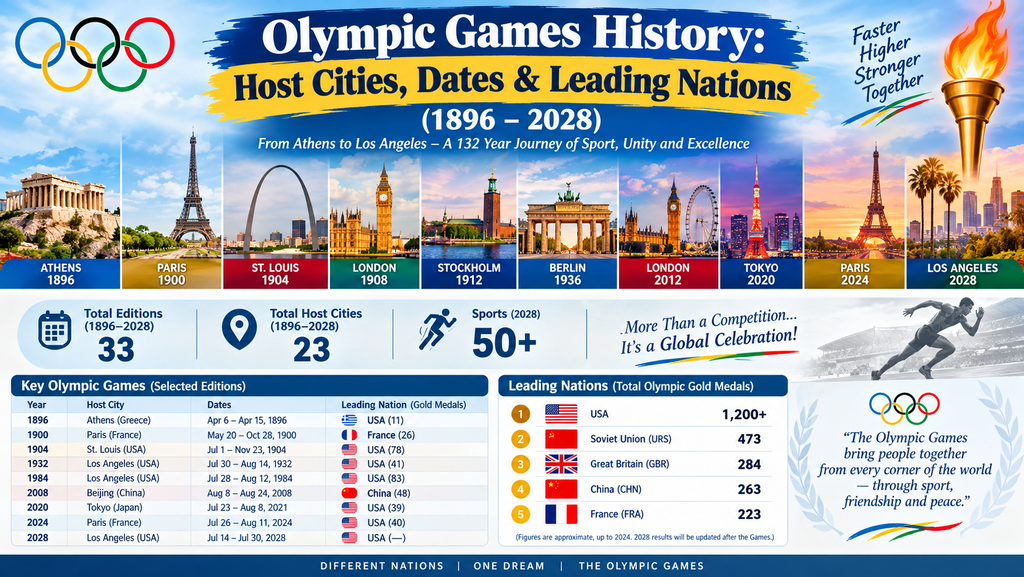
2. Olympic Games History: Host Cities, Dates & Leading Nations (1896–2028)

Below is the chronological journey of the Summer Olympic Games:

YearHost City & NationDatesTop-Ranked Nation
1896Athens, Greece6 April – 15 AprilUnited States
1900Paris, France14 May – 28 October (Note: 11 Feb – 19 Feb)United States
1904St. Louis, USA1 July – 23 November (Note: 4 Feb – 15 Feb)United States
1908London, Great Britain27 April – 31 OctoberGreat Britain
1912Stockholm, Sweden5 May – 22 JulySweden
1916Cancelled due to World War I——
1920Antwerp, Belgium20 April – 12 SeptemberUnited States
1924Paris, France4 May – 27 JulyUnited States
1928Amsterdam, Netherlands17 May – 12 AugustUnited States
1932Los Angeles, USA3 July – 14 AugustUnited States
1936Berlin, Germany1 August – 16 AugustGermany
1940–1944Cancelled due to World War II——
1948London, Great Britain9 July – 10 AugustUnited States
1952Helsinki, Finland19 July – 3 AugustSoviet Union (Russia)
1956Melbourne, Australia22 November – 8 DecemberSoviet Union (Russia)
1960Rome, Italy25 August – 11 SeptemberSoviet Union (Russia)
1964Tokyo, Japan10 October – 24 OctoberUnited States
1968Mexico City, Mexico12 October – 27 OctoberUnited States
1972Munich, West Germany26 August – 10 SeptemberSoviet Union (Russia)
1976Montreal, Canada17 July – 1 AugustSoviet Union (Russia)
1980Moscow, USSR19 July – 3 AugustSoviet Union (Russia)
1984Los Angeles, USA18 July – 12 AugustUnited States
1988Seoul, South Korea17 September – 2 OctoberSoviet Union (Russia)
1992Barcelona, Spain25 July – 7 AugustUnified Team / Russia
1996Atlanta, USA20 July – 4 AugustUnited States
2000Sydney, Australia15 September – 1 OctoberUnited States
2004Athens, Greece13 August – 29 AugustUnited States
2008Beijing, China8 August – 24 AugustUnited States
2012London, Great Britain27 July – 12 AugustUnited States
2016Rio de Janeiro, Brazil5 August – 21 AugustUnited States
2020Tokyo, Japan23 July – 8 August, 2021United States
2024Paris, France26 July – 11 AugustUnited States
2028Los Angeles, USA14 July – 30 JulyUpcoming

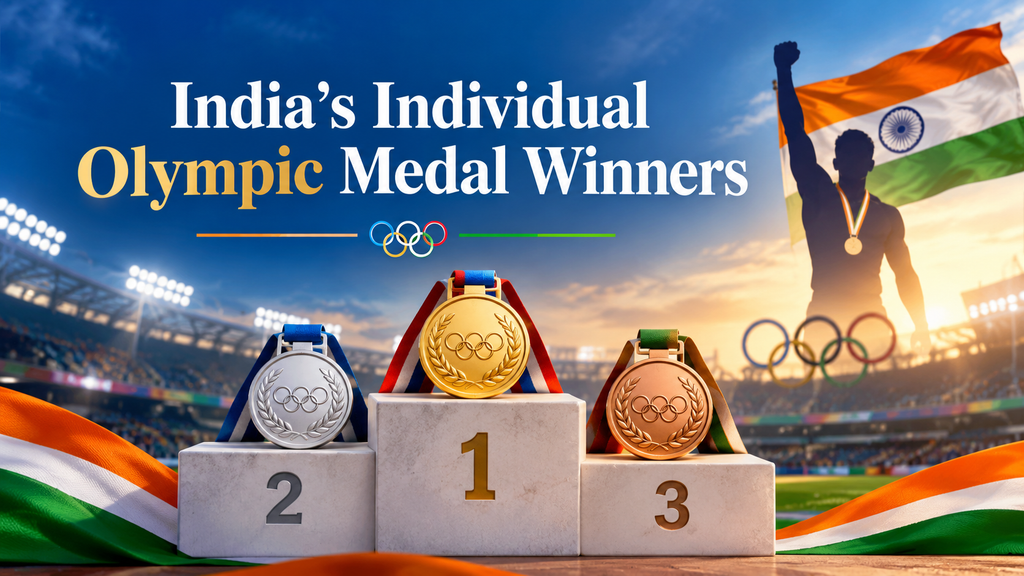
3. India’s Individual Olympic Medal Winners

India’s individual Olympic legacy features standout performances across multiple disciplines:

YearOlympic HostAthlete NameDiscipline & EventMedal
1900ParisNorman PritchardAthletics (200m Sprint – 22.08s)Silver
1900ParisNorman PritchardAthletics (200m Hurdles – 26.06s)Silver
1952HelsinkiKhashaba Dadasaheb JadhavWrestling (Bantamweight)Bronze
1996AtlantaLeander PaesTennis (Men’s Singles)Bronze
2000SydneyKarnam MalleswariWeightlifting (Women’s 69 kg)Bronze
2004AthensRajyavardhan Singh RathoreShooting (Men’s Double Trap)Silver
2008BeijingAbhinav BindraShooting (Men’s 10m Air Rifle)Gold (First Individual Gold)
2008BeijingVijender SinghBoxing (Middleweight)Bronze
2008BeijingSushil KumarWrestling (Men’s 66 kg)Bronze
2012LondonGagan NarangShooting (Men’s 10m Air Rifle)Bronze
2012LondonVijay KumarShooting (Men’s 25m Rapid Fire Pistol)Silver
2012LondonSaina NehwalBadminton (Women’s Singles)Bronze
2012LondonMary KomBoxing (Women’s Flyweight)Bronze
2012LondonYogeshwar DuttWrestling (Men’s 60 kg)Bronze
2012LondonSushil KumarWrestling (Men’s 66 kg)Silver
2016RioP. V. SindhuBadminton (Women’s Singles)Silver
2016RioSakshi MalikWrestling (Women’s 58 kg)Bronze
2020TokyoNeeraj ChopraAthletics (Men’s Javelin Throw)Gold
2020TokyoRavi Kumar DahiyaWrestling (Men’s 57 kg)Silver
2020TokyoMirabai ChanuWeightlifting (Women’s 49 kg)Silver
2020TokyoP. V. SindhuBadminton (Women’s Singles)Bronze
2020TokyoLovlina BorgohainBoxing (Women’s Welterweight)Bronze
2020TokyoBajrang PuniaWrestling (Men’s 65 kg)Bronze

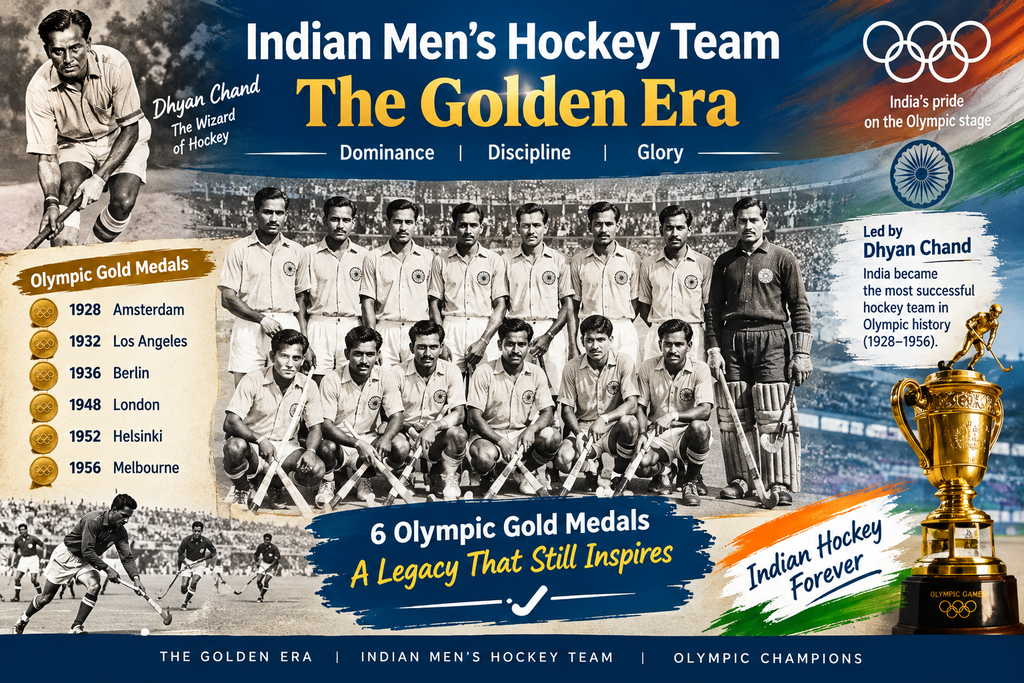
4. Indian Men’s Hockey Team: The Golden Era

Field hockey remains the crown jewel of Indian Olympic history, delivering a record 8 Gold medals:

YearOlympic HostEventMedal
1928AmsterdamMen’s Field HockeyGold
1932Los AngelesMen’s Field HockeyGold
1936BerlinMen’s Field HockeyGold
1948LondonMen’s Field HockeyGold
1952HelsinkiMen’s Field HockeyGold
1956MelbourneMen’s Field HockeyGold
1960RomeMen’s Field HockeySilver
1964TokyoMen’s Field HockeyGold
1968Mexico CityMen’s Field HockeyBronze
1972MunichMen’s Field HockeyBronze
1980MoscowMen’s Field HockeyGold
2020TokyoMen’s Field HockeyBronze

Historic Father-Son Olympic Duos

  • Major Dhyan Chand & Ashok Kumar: Major Dhyan Chand secured Gold in 1936 (Berlin Hockey), while his son Ashok Kumar earned Bronze in 1972 (Munich Hockey).
  • Ahmed Sher Khan & Aslam Sher Khan: Ahmed Sher Khan was part of the 1936 Berlin Gold squad, and his son Aslam Sher Khan won Bronze in 1972 (Munich Hockey).
  • Dr. Vece Paes & Leander Paes: Dr. Vece Paes earned Bronze in 1972 (Munich Hockey), and his son Leander Paes secured Bronze in 1996 (Atlanta Men’s Singles Tennis).

5. Looking Forward: Los Angeles 2028 (LA28)

  • Event: Games of the XXXIV Olympiad (Summer Olympics 2028)
  • Host City: Los Angeles, California, USA
  • Scheduled Dates: 14 July – 30 July 2028
  • Major Highlight: LA28 marks the historic Olympic return of Twenty20 (T20) Cricket after 128 years, alongside newly added disciplines such as baseball/softball, flag football, lacrosse, and squash.

People also read

Important Inventions, Discoveries and Inventors: Complete GK List for Competitive Exams

Important Inventions and Inventors: List, Year, Country & Discoveries

Current Afairs for Competitive Exams in Hindi : 2026 – 2027

Edit Post “Current Afairs for Competitive Exams in Hindi : 2026 – 2027” ‹ Job Express Online — WordPress

BRICS Summit 2026: A Comprehensive Guide to Its Global Impact, Agenda and What Comes Next

BRICS Summit 2026: India, New Delhi Declaration, Members and Key Highlights
जनगणना 2027: भारत की प्रथम डिजिटल जनगणना

जनगणना 2027: भारत की प्रथम डिजिटल जनगणना Explained

Public Examinations (Prevention of Unfair Means) Amendment Act 2026: क्या बदला, नई सजा, जुर्माना और प्रमुख प्रावधान

Public Examinations (Prevention of Unfair Means) Amendment Act 2026:

Prevention of Insults to National Honour Amendment Bill 2026: Vande Mataram Legal Protection : वंदे मातरम् की कानूनी सुरक्षा का विस्तार

Prevention of Insults to National Honour Amendment Bill 2026: Vande Mataram Legal Protection

Commonwealth Games 2026: India Medal Winners, Medal Tally and Important Facts

Commonwealth Games 2026: India Medal Winners, Medal Tally

Indian Classical, Folk and Tribal Dances: Complete List, States, History and Famous Dancers

Indian Classical, Folk and Tribal Dances: Complete List, States, History and Famous Dancers – Job Express Online

How to Kickstart Government Job Prep in 2026

How to Kickstart Government Job Prep in 2026 – Job Express Online

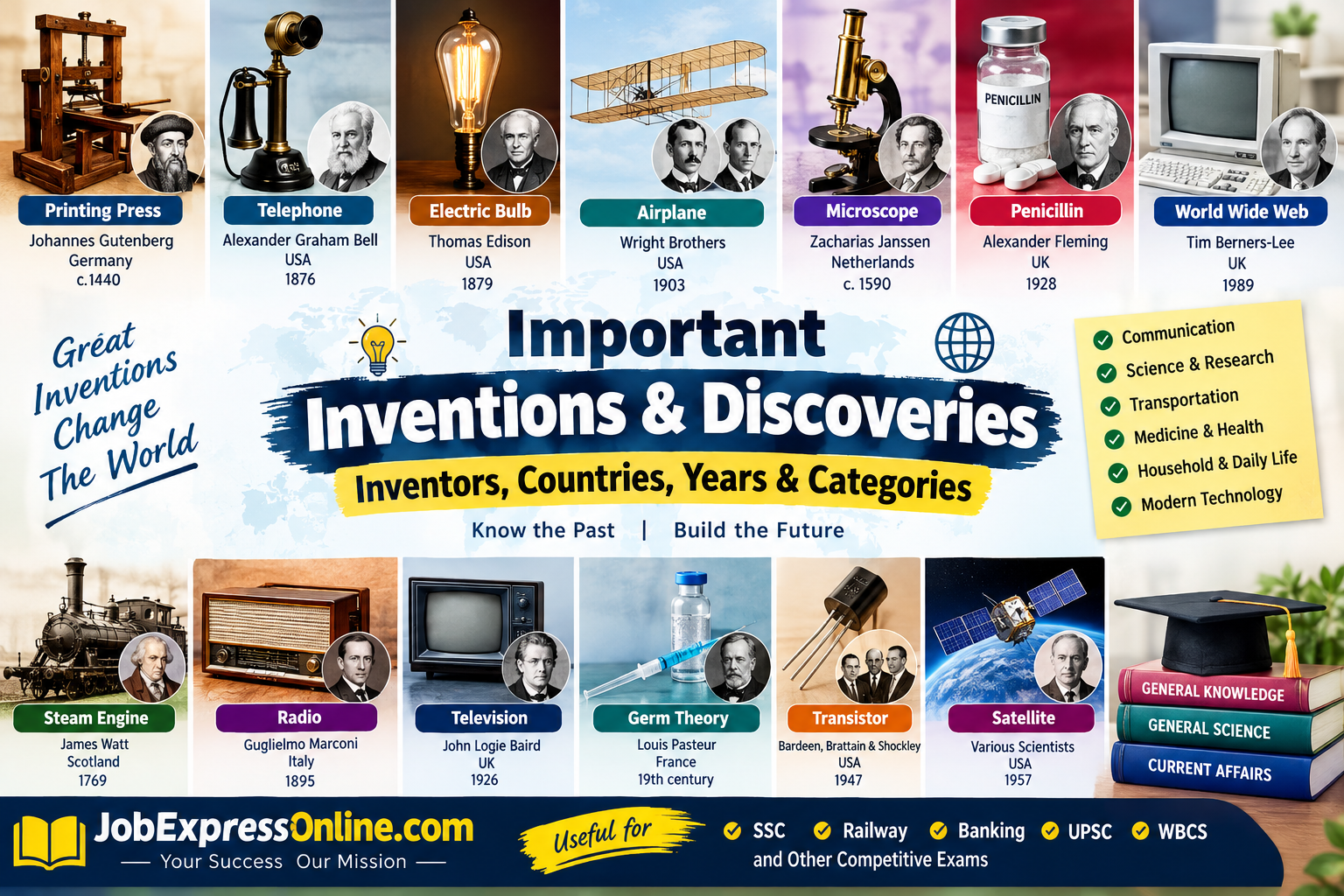
Important Inventions, Discoveries and Inventors: Complete GK List for Competitive Exams

Human civilization has progressed through thousands of important inventions and scientific discoveries. From the printing press and telescope to the telephone, airplane, television, computer and internet, inventions have transformed communication, transportation, medicine, science and everyday life.

For competitive examinations such as SSC, Railway, Banking, UPSC, State PSC, WBCS and other government-job examinations, questions related to inventions and inventors are frequently included in General Knowledge and General Science sections.

This article provides a useful inventions and discoveries list with the inventor or key contributor, country, year and category. Where an invention developed through the work of several people, the table uses the person or people most commonly associated with the relevant milestone.

Important Inventions and Discoveries List :

1. Communication and Information Technology

Invention / DiscoveryInventor / Key ContributorCountryYear
Printing PressJohannes GutenbergGermanyc. 1440
TelegraphSamuel MorseUSA1837
TelephoneAlexander Graham BellUSA1876
PhonographThomas EdisonUSA1877
Radio / Wireless TelegraphyGuglielmo MarconiItaly1895
Television – Mechanical SystemJohn Logie BairdUK1926
Television – Electronic SystemPhilo FarnsworthUSA1927
RadarRobert Watson-Watt and othersUK1930s
TransistorBardeen, Brattain and ShockleyUSA1947
Computer – Early Electronic ComputerMultiple contributorsUSA/UK1940s
MicroprocessorIntel teamUSA1971
EmailRay TomlinsonUSA1971
Mobile PhoneMartin CooperUSA1973
World Wide WebTim Berners-LeeUK1989

The Library of Congress records Bell’s successful telephone patent and 1876 demonstrations, while Library of Congress telecommunications history places Morse’s first public telegraph message in 1844 and Marconi’s wireless work in the late 19th century.

2. Science and Measurement

Invention / DiscoveryInventor / Key ContributorCountryYear
MicroscopeZacharias Janssen – commonly creditedNetherlandsc. 1590
TelescopeHans Lippershey – commonly creditedNetherlands1608
ThermometerGalileo Galilei – early thermoscopeItalyc. 1593
BarometerEvangelista TorricelliItaly1643
Pendulum ClockChristiaan HuygensNetherlands1656
Calculating MachineBlaise PascalFrance1642
Lightning RodBenjamin FranklinUSA1752
Electromagnetic InductionMichael FaradayUK1831
X-RayWilhelm Conrad RöntgenGermany1895
RadioactivityHenri BecquerelFrance1896
RadiumMarie Curie and Pierre CurieFrance/Poland1898
Electron – DiscoveryJ. J. ThomsonUK1897
Atomic TheoryJohn DaltonUK1803
Quantum TheoryMax PlanckGermany1900
Theory of RelativityAlbert EinsteinGermany/Switzerland1905

Exam note: The dates of some early instruments can vary because their development was gradual. For example, sources commonly list the telescope around 1608 and the microscope around 1590.

3. Transportation and Engineering

InventionInventor / Key ContributorCountryYear
Steam EngineThomas Newcomen; later improved by James WattEngland/Scotland1712/1769
Steam LocomotiveRichard TrevithickUK1804
Railway LocomotiveGeorge StephensonUK1814
BicycleKirkpatrick Macmillan – commonly creditedScotland1839
AutomobileKarl BenzGermany1885–1886
MotorcycleGottlieb Daimler and Wilhelm MaybachGermany1885
Diesel EngineRudolf DieselGermany1897
AirplaneWilbur and Orville WrightUSA1903
HelicopterIgor SikorskyUSA1939

The Smithsonian records the Wright brothers’ 1903 Flyer as the first successful powered airplane with a pilot aboard, with its first flight on December 17, 1903, in the United States.

4. Medical Science and Medicine

Invention / DiscoveryInventor / ScientistCountryYear
StethoscopeRené LaennecFrance1816
Anesthesia – Ether Use in SurgeryWilliam T. G. Morton and othersUSA1846
Germ TheoryLouis Pasteur and othersFrance19th century
Antiseptic SurgeryJoseph ListerUK1860s
Blood CirculationWilliam HarveyEngland1628
Smallpox VaccineEdward JennerEngland1796
PenicillinAlexander FlemingUK1928
Insulin – Therapeutic DevelopmentBanting, Best, Macleod and CollipCanada1921–1922
StreptomycinSelman Waksman and Albert SchatzUSA1943
Polio Vaccine – OralAlbert SabinUSA1961
Open-heart Surgery – Major DevelopmentVarious surgeonsMultiple countries20th century

Important distinction: discoveries such as blood circulation or radioactivity should technically be called discoveries, while devices such as the stethoscope are inventions. Keeping both under “Inventions and Discoveries” makes the article more accurate for GK purposes.

5. Household and Everyday Inventions

InventionInventor / Key ContributorCountryYear
Safety PinWalter HuntUSA1849
Sewing MachineBarthélemy Thimonnier and othersFrance1830
Refrigerator – Early Mechanical DesignJacob PerkinsUK1834
Electric Bulb – Practical Incandescent LampThomas Edison and othersUSA1879
Safety RazorKing C. GilletteUSA1901
Washing Machine – Early Electric ModelsMultiple inventorsUSA/EuropeEarly 20th century
Ballpoint PenLászló BíróHungary1938
NylonWallace H. Carothers and DuPont teamUSA1935
Stainless SteelHarry Brearley – commonly creditedUK1913
Terylene / PolyesterJ. R. Whinfield and J. T. DicksonUK1941
Electric TransformerWilliam StanleyUSA1885

6. Modern Technology

Invention / TechnologyKey ContributorCountryYear
Optical Fibre CommunicationNarinder Singh Kapany and othersIndia/UK1950s–1960s
Integrated CircuitJack Kilby and Robert NoyceUSA1958–1959
LaserTheodore Maiman and earlier contributorsUSA1960
MicroprocessorIntel teamUSA1971
Personal ComputerMultiple contributorsUSA1970s
Mobile PhoneMartin CooperUSA1973
Internet – DevelopmentMultiple researchersUSA/UK and others1960s–1980s
World Wide WebTim Berners-LeeUK1989
USBAjay Bhatt and Intel teamUSA1990s

7. Important Inventions for Competitive Exams – Quick Revision

These are some of the most useful inventor–invention pairs to remember:

InventionInventorYear
Printing PressJohannes Gutenbergc. 1440
TelescopeHans Lippershey1608
BarometerEvangelista Torricelli1643
Steam EngineThomas Newcomen / James Watt1712 / 1769
Smallpox VaccineEdward Jenner1796
BatteryAlessandro Volta1800
Electromagnetic InductionMichael Faraday1831
TelegraphSamuel Morse1837
TelephoneAlexander Graham Bell1876
PhonographThomas Edison1877
Electric BulbThomas Edison and others1879
AutomobileKarl Benz1885–86
RadioGuglielmo Marconi1895
X-RayWilhelm Röntgen1895
Diesel EngineRudolf Diesel1897
AirplaneWright Brothers1903
TelevisionJohn Logie Baird1926
PenicillinAlexander Fleming1928
Ballpoint PenLászló Bíró1938
TransistorBardeen, Brattain & Shockley1947
LaserTheodore Maiman1960
Mobile PhoneMartin Cooper1973
World Wide WebTim Berners-Lee1989

Important Note About “Inventor” Questions

Many GK books present an invention as if it was created by one person on one exact date. In reality, several inventions developed gradually through the contributions of multiple scientists and engineers.

For example:

  • Steam engine: Thomas Newcomen developed an early practical atmospheric steam engine; James Watt later made major improvements.
  • Telephone: Bell is commonly credited because of his successful patented design and demonstrations, although other inventors also worked on voice communication.https://www.loc.gov/everyday-mysteries/categories/technology/item/who-is-credited-with-inventing-the-telephone/
  • Radio: Marconi is commonly associated with wireless telegraphy, but radio technology developed through contributions from several scientists.
  • Television: Baird is associated with early mechanical television, while electronic television involved other major contributors.
  • Airplane: The Wright brothers’ 1903 flight is the milestone commonly used in GK questions for the first successful powered, controlled heavier-than-air flight.

Therefore, for competitive-exam preparation, students should remember the commonly accepted exam pair, while understanding that the complete historical story can be more complicated.

Conclusion

Inventions and scientific discoveries have played a major role in shaping modern civilization. Learning the names of important inventors, their inventions, countries and years is especially useful for General Knowledge and General Science preparation.

For competitive examinations, candidates should focus particularly on frequently asked pairs such as Gutenberg–Printing Press, Bell–Telephone, Edison–Electric Bulb, Marconi–Radio, Röntgen–X-Ray, Fleming–Penicillin, Wright Brothers–Airplane and Tim Berners-Lee–World Wide Web.

Regular revision through short tables and one-line questions can make this topic easier to remember for SSC, Railway, Banking, UPSC, WBCS and other competitive examinations.

People Also Read

Current Afairs for Competitive Exams in Hindi : 2026 – 2027

Current Afairs for Competitive Exams in Hindi : 2026 – 2027

BRICS Summit 2026: A Comprehensive Guide to Its Global Impact, Agenda and What Comes Next

BRICS Summit 2026: India, New Delhi Declaration, Members and Key Highlights
जनगणना 2027: भारत की प्रथम डिजिटल जनगणना

जनगणना 2027: भारत की प्रथम डिजिटल जनगणना Explained

Public Examinations (Prevention of Unfair Means) Amendment Act 2026: क्या बदला, नई सजा, जुर्माना और प्रमुख प्रावधान

Public Examinations (Prevention of Unfair Means) Amendment Act 2026:

Prevention of Insults to National Honour Amendment Bill 2026: Vande Mataram Legal Protection : वंदे मातरम् की कानूनी सुरक्षा का विस्तार

Prevention of Insults to National Honour Amendment Bill 2026: Vande Mataram Legal Protection

Commonwealth Games 2026: India Medal Winners, Medal Tally and Important Facts

Commonwealth Games 2026: India Medal Winners, Medal Tally

Commonwealth Games 2026: India Medal Winners, Medal Tally

Indian Classical, Folk and Tribal Dances: Complete List, States, History and Famous Dancers – Job Express Online

How to Kickstart Government Job Prep in 2026

How to Kickstart Government Job Prep in 2026 – Job Express Online