Olympic Games History: Host Cities, India’s Medal Winners & Important Facts

Olympic Games History dates back to the ancient Olympic Games held in Olympia, Greece. The modern Olympic Games were revived in 1896 in Athens under the leadership of Pierre de Coubertin and have since become a major international sporting event.

In this article, we will explore the Olympic Games History, including the ancient and modern Olympics, important milestones, host countries, India’s medal winners and key facts useful for competitive exams and general knowledge.

Ancient vs. Modern Origins

  • Ancient Olympics: The ancient games trace back to 776 BC in Olympia, Greece, celebrated as a religious and athletic festival in honor of Zeus.
  • Modern Olympics: After centuries of dormancy, the first Modern Summer Olympic Games were inaugurated in 1896 in Athens, Greece.

The Father of the Modern Olympics

  • French educator and historian Baron Pierre de Coubertin is revered as the Father of the Modern Olympic Games. He established the International Olympic Committee (IOC) in 1894 to foster global peace through athletic competition.

The Olympic Symbol & Rings
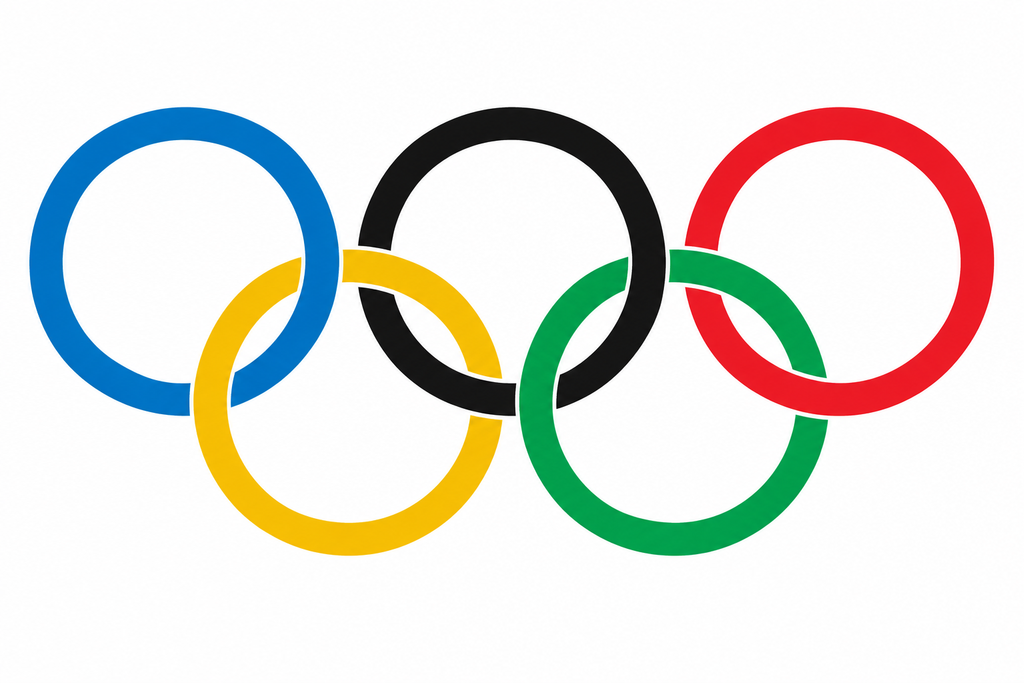
  • The Olympic Flag made its debut at the 1920 Antwerp Games.
  • The five interlaced rings on a white backdrop represent the union of five inhabited continents and the meeting of athletes worldwide:
    • Blue: Europe
    • Yellow: Asia
    • Black: Africa
    • Green: Oceania / Australia
    • Red: Americas

Olympic Motto & Flame

  • Olympic Motto: Citius, Altius, Fortius (Latin for “Faster, Higher, Stronger”).
  • Olympic Flame (Sacred Fire): The modern tradition of the Olympic Flame was reintroduced during the 1928 Amsterdam Olympic Games, followed by the iconic Olympic Torch Relay starting from the 1936 Berlin Games.

https://www.olympics.com/en/olympic-games

2. Olympic Games History: Host Cities, Dates & Leading Nations (1896–2028)
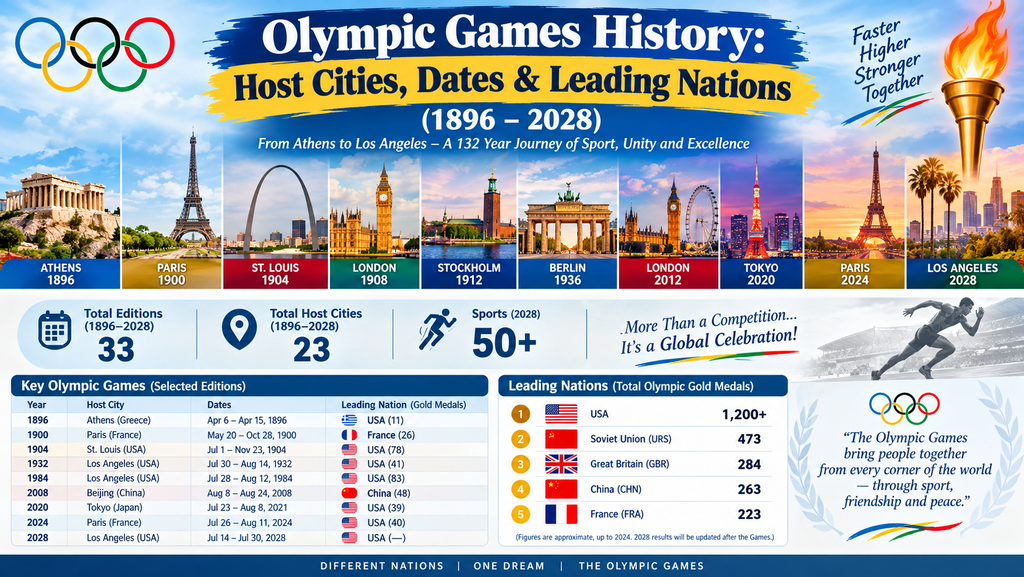
Below is the chronological journey of the Summer Olympic Games:

YearHost City & NationDatesTop-Ranked Nation
1896Athens, Greece6 April – 15 AprilUnited States
1900Paris, France14 May – 28 October (Note: 11 Feb – 19 Feb)United States
1904St. Louis, USA1 July – 23 November (Note: 4 Feb – 15 Feb)United States
1908London, Great Britain27 April – 31 OctoberGreat Britain
1912Stockholm, Sweden5 May – 22 JulySweden
1916Cancelled due to World War I——
1920Antwerp, Belgium20 April – 12 SeptemberUnited States
1924Paris, France4 May – 27 JulyUnited States
1928Amsterdam, Netherlands17 May – 12 AugustUnited States
1932Los Angeles, USA3 July – 14 AugustUnited States
1936Berlin, Germany1 August – 16 AugustGermany
1940–1944Cancelled due to World War II——
1948London, Great Britain9 July – 10 AugustUnited States
1952Helsinki, Finland19 July – 3 AugustSoviet Union (Russia)
1956Melbourne, Australia22 November – 8 DecemberSoviet Union (Russia)
1960Rome, Italy25 August – 11 SeptemberSoviet Union (Russia)
1964Tokyo, Japan10 October – 24 OctoberUnited States
1968Mexico City, Mexico12 October – 27 OctoberUnited States
1972Munich, West Germany26 August – 10 SeptemberSoviet Union (Russia)
1976Montreal, Canada17 July – 1 AugustSoviet Union (Russia)
1980Moscow, USSR19 July – 3 AugustSoviet Union (Russia)
1984Los Angeles, USA18 July – 12 AugustUnited States
1988Seoul, South Korea17 September – 2 OctoberSoviet Union (Russia)
1992Barcelona, Spain25 July – 7 AugustUnified Team / Russia
1996Atlanta, USA20 July – 4 AugustUnited States
2000Sydney, Australia15 September – 1 OctoberUnited States
2004Athens, Greece13 August – 29 AugustUnited States
2008Beijing, China8 August – 24 AugustUnited States
2012London, Great Britain27 July – 12 AugustUnited States
2016Rio de Janeiro, Brazil5 August – 21 AugustUnited States
2020Tokyo, Japan23 July – 8 August, 2021United States
2024Paris, France26 July – 11 AugustUnited States
2028Los Angeles, USA14 July – 30 JulyUpcoming

3. India’s Individual Olympic Medal Winners
India’s individual Olympic legacy features standout performances across multiple disciplines:

YearOlympic HostAthlete NameDiscipline & EventMedal
1900ParisNorman PritchardAthletics (200m Sprint – 22.08s)Silver
1900ParisNorman PritchardAthletics (200m Hurdles – 26.06s)Silver
1952HelsinkiKhashaba Dadasaheb JadhavWrestling (Bantamweight)Bronze
1996AtlantaLeander PaesTennis (Men’s Singles)Bronze
2000SydneyKarnam MalleswariWeightlifting (Women’s 69 kg)Bronze
2004AthensRajyavardhan Singh RathoreShooting (Men’s Double Trap)Silver
2008BeijingAbhinav BindraShooting (Men’s 10m Air Rifle)Gold (First Individual Gold)
2008BeijingVijender SinghBoxing (Middleweight)Bronze
2008BeijingSushil KumarWrestling (Men’s 66 kg)Bronze
2012LondonGagan NarangShooting (Men’s 10m Air Rifle)Bronze
2012LondonVijay KumarShooting (Men’s 25m Rapid Fire Pistol)Silver
2012LondonSaina NehwalBadminton (Women’s Singles)Bronze
2012LondonMary KomBoxing (Women’s Flyweight)Bronze
2012LondonYogeshwar DuttWrestling (Men’s 60 kg)Bronze
2012LondonSushil KumarWrestling (Men’s 66 kg)Silver
2016RioP. V. SindhuBadminton (Women’s Singles)Silver
2016RioSakshi MalikWrestling (Women’s 58 kg)Bronze
2020TokyoNeeraj ChopraAthletics (Men’s Javelin Throw)Gold
2020TokyoRavi Kumar DahiyaWrestling (Men’s 57 kg)Silver
2020TokyoMirabai ChanuWeightlifting (Women’s 49 kg)Silver
2020TokyoP. V. SindhuBadminton (Women’s Singles)Bronze
2020TokyoLovlina BorgohainBoxing (Women’s Welterweight)Bronze
2020TokyoBajrang PuniaWrestling (Men’s 65 kg)Bronze

4. Indian Men’s Hockey Team: The Golden Era
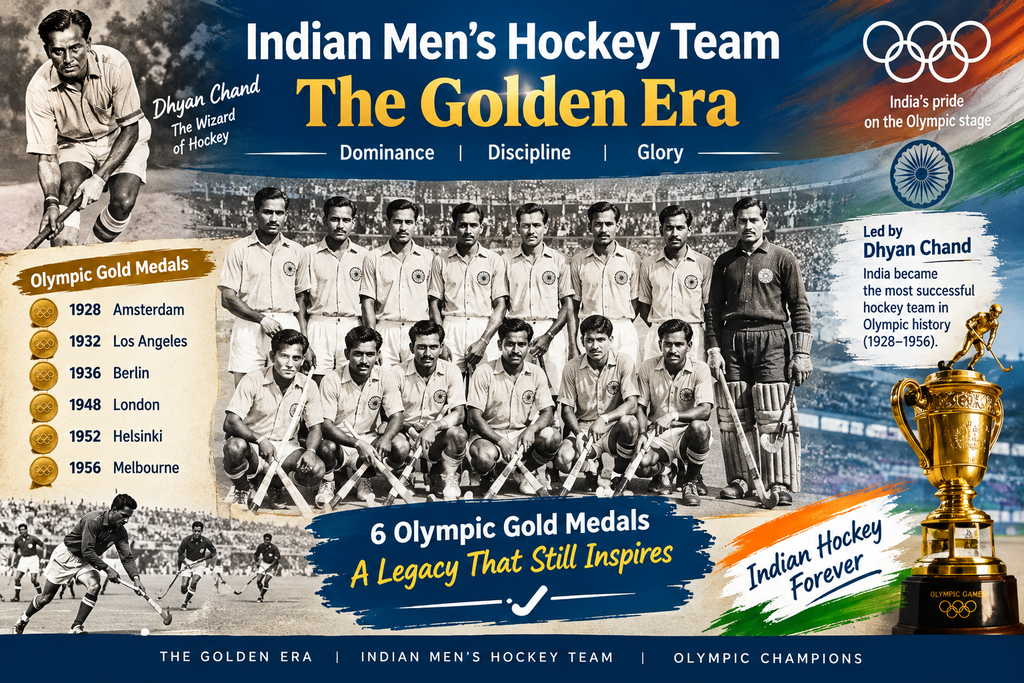
Field hockey remains the crown jewel of Indian Olympic history, delivering a record 8 Gold medals:

YearOlympic HostEventMedal
1928AmsterdamMen’s Field HockeyGold
1932Los AngelesMen’s Field HockeyGold
1936BerlinMen’s Field HockeyGold
1948LondonMen’s Field HockeyGold
1952HelsinkiMen’s Field HockeyGold
1956MelbourneMen’s Field HockeyGold
1960RomeMen’s Field HockeySilver
1964TokyoMen’s Field HockeyGold
1968Mexico CityMen’s Field HockeyBronze
1972MunichMen’s Field HockeyBronze
1980MoscowMen’s Field HockeyGold
2020TokyoMen’s Field HockeyBronze

Historic Father-Son Olympic Duos

  • Major Dhyan Chand & Ashok Kumar: Major Dhyan Chand secured Gold in 1936 (Berlin Hockey), while his son Ashok Kumar earned Bronze in 1972 (Munich Hockey).
  • Ahmed Sher Khan & Aslam Sher Khan: Ahmed Sher Khan was part of the 1936 Berlin Gold squad, and his son Aslam Sher Khan won Bronze in 1972 (Munich Hockey).
  • Dr. Vece Paes & Leander Paes: Dr. Vece Paes earned Bronze in 1972 (Munich Hockey), and his son Leander Paes secured Bronze in 1996 (Atlanta Men’s Singles Tennis).

5. Looking Forward: Los Angeles 2028 (LA28)

  • Event: Games of the XXXIV Olympiad (Summer Olympics 2028)
  • Host City: Los Angeles, California, USA
  • Scheduled Dates: 14 July – 30 July 2028
  • Major Highlight: LA28 marks the historic Olympic return of Twenty20 (T20) Cricket after 128 years, alongside newly added disciplines such as baseball/softball, flag football, lacrosse, and squash.

People also read

Important Inventions, Discoveries and Inventors: Complete GK List for Competitive Exams

Important Inventions and Inventors: List, Year, Country & Discoveries

Current Afairs for Competitive Exams in Hindi : 2026 – 2027

Edit Post “Current Afairs for Competitive Exams in Hindi : 2026 – 2027” ‹ Job Express Online — WordPress

BRICS Summit 2026: A Comprehensive Guide to Its Global Impact, Agenda and What Comes Next

BRICS Summit 2026: India, New Delhi Declaration, Members and Key Highlights

जनगणना 2027: भारत की प्रथम डिजिटल जनगणना

जनगणना 2027: भारत की प्रथम डिजिटल जनगणना Explained

Public Examinations (Prevention of Unfair Means) Amendment Act 2026: क्या बदला, नई सजा, जुर्माना और प्रमुख प्रावधान

Public Examinations (Prevention of Unfair Means) Amendment Act 2026:

Prevention of Insults to National Honour Amendment Bill 2026: Vande Mataram Legal Protection : वंदे मातरम् की कानूनी सुरक्षा का विस्तार

Prevention of Insults to National Honour Amendment Bill 2026: Vande Mataram Legal Protection

Commonwealth Games 2026: India Medal Winners, Medal Tally and Important Facts

Commonwealth Games 2026: India Medal Winners, Medal Tally

Indian Classical, Folk and Tribal Dances: Complete List, States, History and Famous Dancers

Indian Classical, Folk and Tribal Dances: Complete List, States, History and Famous Dancers – Job Express Online

How to Kickstart Government Job Prep in 2026

How to Kickstart Government Job Prep in 2026 – Job Express Online
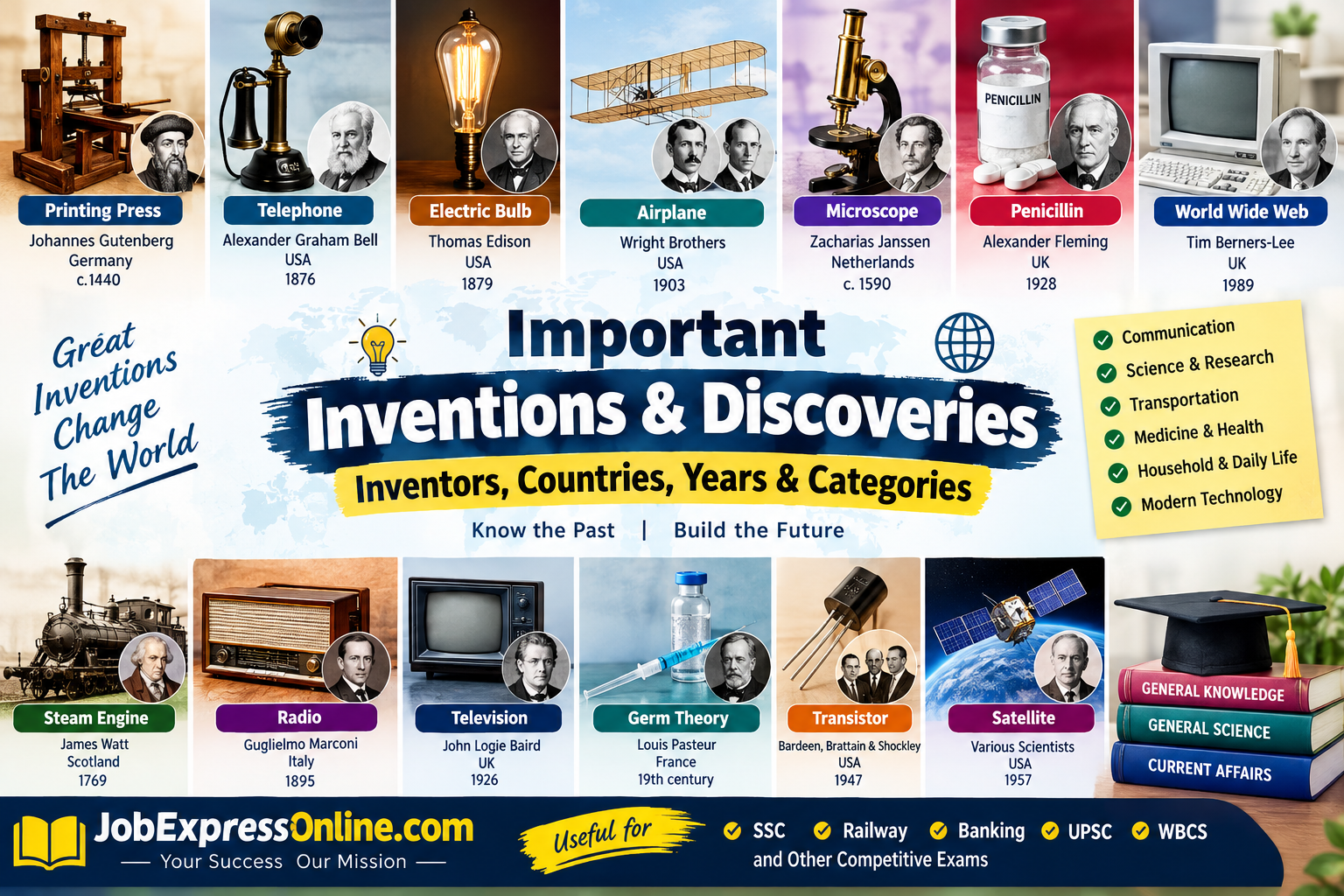
Important Inventions, Discoveries and Inventors: Complete GK List for Competitive Exams

Human civilization has progressed through thousands of important inventions and scientific discoveries. From the printing press and telescope to the telephone, airplane, television, computer and internet, inventions have transformed communication, transportation, medicine, science and everyday life.

For competitive examinations such as SSC, Railway, Banking, UPSC, State PSC, WBCS and other government-job examinations, questions related to inventions and inventors are frequently included in General Knowledge and General Science sections.

This article provides a useful inventions and discoveries list with the inventor or key contributor, country, year and category. Where an invention developed through the work of several people, the table uses the person or people most commonly associated with the relevant milestone.

Important Inventions and Discoveries List :

1. Communication and Information Technology

Invention / DiscoveryInventor / Key ContributorCountryYear
Printing PressJohannes GutenbergGermanyc. 1440
TelegraphSamuel MorseUSA1837
TelephoneAlexander Graham BellUSA1876
PhonographThomas EdisonUSA1877
Radio / Wireless TelegraphyGuglielmo MarconiItaly1895
Television – Mechanical SystemJohn Logie BairdUK1926
Television – Electronic SystemPhilo FarnsworthUSA1927
RadarRobert Watson-Watt and othersUK1930s
TransistorBardeen, Brattain and ShockleyUSA1947
Computer – Early Electronic ComputerMultiple contributorsUSA/UK1940s
MicroprocessorIntel teamUSA1971
EmailRay TomlinsonUSA1971
Mobile PhoneMartin CooperUSA1973
World Wide WebTim Berners-LeeUK1989

The Library of Congress records Bell’s successful telephone patent and 1876 demonstrations, while Library of Congress telecommunications history places Morse’s first public telegraph message in 1844 and Marconi’s wireless work in the late 19th century.

2. Science and Measurement

Invention / DiscoveryInventor / Key ContributorCountryYear
MicroscopeZacharias Janssen – commonly creditedNetherlandsc. 1590
TelescopeHans Lippershey – commonly creditedNetherlands1608
ThermometerGalileo Galilei – early thermoscopeItalyc. 1593
BarometerEvangelista TorricelliItaly1643
Pendulum ClockChristiaan HuygensNetherlands1656
Calculating MachineBlaise PascalFrance1642
Lightning RodBenjamin FranklinUSA1752
Electromagnetic InductionMichael FaradayUK1831
X-RayWilhelm Conrad RöntgenGermany1895
RadioactivityHenri BecquerelFrance1896
RadiumMarie Curie and Pierre CurieFrance/Poland1898
Electron – DiscoveryJ. J. ThomsonUK1897
Atomic TheoryJohn DaltonUK1803
Quantum TheoryMax PlanckGermany1900
Theory of RelativityAlbert EinsteinGermany/Switzerland1905

Exam note: The dates of some early instruments can vary because their development was gradual. For example, sources commonly list the telescope around 1608 and the microscope around 1590.

3. Transportation and Engineering

InventionInventor / Key ContributorCountryYear
Steam EngineThomas Newcomen; later improved by James WattEngland/Scotland1712/1769
Steam LocomotiveRichard TrevithickUK1804
Railway LocomotiveGeorge StephensonUK1814
BicycleKirkpatrick Macmillan – commonly creditedScotland1839
AutomobileKarl BenzGermany1885–1886
MotorcycleGottlieb Daimler and Wilhelm MaybachGermany1885
Diesel EngineRudolf DieselGermany1897
AirplaneWilbur and Orville WrightUSA1903
HelicopterIgor SikorskyUSA1939

The Smithsonian records the Wright brothers’ 1903 Flyer as the first successful powered airplane with a pilot aboard, with its first flight on December 17, 1903, in the United States.

4. Medical Science and Medicine

Invention / DiscoveryInventor / ScientistCountryYear
StethoscopeRené LaennecFrance1816
Anesthesia – Ether Use in SurgeryWilliam T. G. Morton and othersUSA1846
Germ TheoryLouis Pasteur and othersFrance19th century
Antiseptic SurgeryJoseph ListerUK1860s
Blood CirculationWilliam HarveyEngland1628
Smallpox VaccineEdward JennerEngland1796
PenicillinAlexander FlemingUK1928
Insulin – Therapeutic DevelopmentBanting, Best, Macleod and CollipCanada1921–1922
StreptomycinSelman Waksman and Albert SchatzUSA1943
Polio Vaccine – OralAlbert SabinUSA1961
Open-heart Surgery – Major DevelopmentVarious surgeonsMultiple countries20th century

Important distinction: discoveries such as blood circulation or radioactivity should technically be called discoveries, while devices such as the stethoscope are inventions. Keeping both under “Inventions and Discoveries” makes the article more accurate for GK purposes.

5. Household and Everyday Inventions

InventionInventor / Key ContributorCountryYear
Safety PinWalter HuntUSA1849
Sewing MachineBarthélemy Thimonnier and othersFrance1830
Refrigerator – Early Mechanical DesignJacob PerkinsUK1834
Electric Bulb – Practical Incandescent LampThomas Edison and othersUSA1879
Safety RazorKing C. GilletteUSA1901
Washing Machine – Early Electric ModelsMultiple inventorsUSA/EuropeEarly 20th century
Ballpoint PenLászló BíróHungary1938
NylonWallace H. Carothers and DuPont teamUSA1935
Stainless SteelHarry Brearley – commonly creditedUK1913
Terylene / PolyesterJ. R. Whinfield and J. T. DicksonUK1941
Electric TransformerWilliam StanleyUSA1885

6. Modern Technology

Invention / TechnologyKey ContributorCountryYear
Optical Fibre CommunicationNarinder Singh Kapany and othersIndia/UK1950s–1960s
Integrated CircuitJack Kilby and Robert NoyceUSA1958–1959
LaserTheodore Maiman and earlier contributorsUSA1960
MicroprocessorIntel teamUSA1971
Personal ComputerMultiple contributorsUSA1970s
Mobile PhoneMartin CooperUSA1973
Internet – DevelopmentMultiple researchersUSA/UK and others1960s–1980s
World Wide WebTim Berners-LeeUK1989
USBAjay Bhatt and Intel teamUSA1990s

7. Important Inventions for Competitive Exams – Quick Revision

These are some of the most useful inventor–invention pairs to remember:

InventionInventorYear
Printing PressJohannes Gutenbergc. 1440
TelescopeHans Lippershey1608
BarometerEvangelista Torricelli1643
Steam EngineThomas Newcomen / James Watt1712 / 1769
Smallpox VaccineEdward Jenner1796
BatteryAlessandro Volta1800
Electromagnetic InductionMichael Faraday1831
TelegraphSamuel Morse1837
TelephoneAlexander Graham Bell1876
PhonographThomas Edison1877
Electric BulbThomas Edison and others1879
AutomobileKarl Benz1885–86
RadioGuglielmo Marconi1895
X-RayWilhelm Röntgen1895
Diesel EngineRudolf Diesel1897
AirplaneWright Brothers1903
TelevisionJohn Logie Baird1926
PenicillinAlexander Fleming1928
Ballpoint PenLászló Bíró1938
TransistorBardeen, Brattain & Shockley1947
LaserTheodore Maiman1960
Mobile PhoneMartin Cooper1973
World Wide WebTim Berners-Lee1989

Important Note About “Inventor” Questions

Many GK books present an invention as if it was created by one person on one exact date. In reality, several inventions developed gradually through the contributions of multiple scientists and engineers.

For example:

  • Steam engine: Thomas Newcomen developed an early practical atmospheric steam engine; James Watt later made major improvements.
  • Telephone: Bell is commonly credited because of his successful patented design and demonstrations, although other inventors also worked on voice communication.https://www.loc.gov/everyday-mysteries/categories/technology/item/who-is-credited-with-inventing-the-telephone/
  • Radio: Marconi is commonly associated with wireless telegraphy, but radio technology developed through contributions from several scientists.
  • Television: Baird is associated with early mechanical television, while electronic television involved other major contributors.
  • Airplane: The Wright brothers’ 1903 flight is the milestone commonly used in GK questions for the first successful powered, controlled heavier-than-air flight.

Therefore, for competitive-exam preparation, students should remember the commonly accepted exam pair, while understanding that the complete historical story can be more complicated.

Conclusion

Inventions and scientific discoveries have played a major role in shaping modern civilization. Learning the names of important inventors, their inventions, countries and years is especially useful for General Knowledge and General Science preparation.

For competitive examinations, candidates should focus particularly on frequently asked pairs such as Gutenberg–Printing Press, Bell–Telephone, Edison–Electric Bulb, Marconi–Radio, Röntgen–X-Ray, Fleming–Penicillin, Wright Brothers–Airplane and Tim Berners-Lee–World Wide Web.

Regular revision through short tables and one-line questions can make this topic easier to remember for SSC, Railway, Banking, UPSC, WBCS and other competitive examinations.

People Also Read

Current Afairs for Competitive Exams in Hindi : 2026 – 2027

Current Afairs for Competitive Exams in Hindi : 2026 – 2027

BRICS Summit 2026: A Comprehensive Guide to Its Global Impact, Agenda and What Comes Next

BRICS Summit 2026: India, New Delhi Declaration, Members and Key Highlights

जनगणना 2027: भारत की प्रथम डिजिटल जनगणना

जनगणना 2027: भारत की प्रथम डिजिटल जनगणना Explained

Public Examinations (Prevention of Unfair Means) Amendment Act 2026: क्या बदला, नई सजा, जुर्माना और प्रमुख प्रावधान

Public Examinations (Prevention of Unfair Means) Amendment Act 2026:

Prevention of Insults to National Honour Amendment Bill 2026: Vande Mataram Legal Protection : वंदे मातरम् की कानूनी सुरक्षा का विस्तार

Prevention of Insults to National Honour Amendment Bill 2026: Vande Mataram Legal Protection

Commonwealth Games 2026: India Medal Winners, Medal Tally and Important Facts

Commonwealth Games 2026: India Medal Winners, Medal Tally

Commonwealth Games 2026: India Medal Winners, Medal Tally

Indian Classical, Folk and Tribal Dances: Complete List, States, History and Famous Dancers – Job Express Online

How to Kickstart Government Job Prep in 2026

How to Kickstart Government Job Prep in 2026 – Job Express Online